Ch. 4 - Microscopy, Staining, and Classification
Bauman - Microbiology with Diseases by Taxonomy 6th Edition
Bauman6th EditionMicrobiology with Diseases by TaxonomyISBN: 9780134832302당신이 사용하는 게 아니라요?교과서 변경
4장, 문제 1

If an objective magnifies 40× and each binocular lens magnifies 15×, the total magnification of the object being viewed is ________.

검증된 단계별 안내
1
Identify the magnification of the objective lens, which is given as 40×.
Identify the magnification of each binocular (ocular) lens, which is given as 15×.
Recall that the total magnification of a compound microscope is calculated by multiplying the magnification of the objective lens by the magnification of the ocular lens.
Write the formula for total magnification as: \(\text{Total Magnification} = \text{Objective Magnification} \times \text{Ocular Magnification}\).
Substitute the given values into the formula: \(\text{Total Magnification} = 40 \times 15\) and then multiply to find the total magnification.

비슷한 문제에 대한 검증된 영상 답변:

이 영상 해법은 위 문제에 도움이 된다고 튜터들이 추천한 것입니다.
영상 길이:
2m
도움이 되었나요?

주요 개념

질문에 올바르게 답하기 위해 반드시 이해해야 하는 핵심 개념들은 다음과 같습니다.

Objective Lens Magnification

The objective lens is the primary lens in a microscope that is closest to the specimen. Its magnification power determines how much the specimen is enlarged initially, such as 40× in this case.
추천 영상:
가이드 코스
07:29
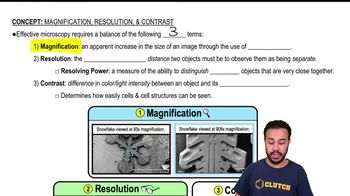
Magnification, Resolution, & Contrast

Ocular (Binocular) Lens Magnification

The ocular lenses, or eyepieces, are the lenses you look through, typically magnifying the image produced by the objective lens. Each binocular lens magnifies the image further, here by 15×.
추천 영상:
가이드 코스
07:29
Magnification, Resolution, & Contrast

Total Magnification Calculation

Total magnification is found by multiplying the magnification of the objective lens by that of the ocular lens. For example, 40× objective multiplied by 15× ocular results in a total magnification of 600×.
추천 영상:
가이드 코스
07:29
Magnification, Resolution, & Contrast