Ch. 4 - Microscopy, Staining, and Classification
Bauman - Microbiology with Diseases by Taxonomy 6th Edition
Bauman6th EditionMicrobiology with Diseases by TaxonomyISBN: 9780134832302당신이 사용하는 게 아니라요?교과서 변경
4장, 문제 1

Explain how the principle, “electrons travel as waves,” applies to microscopy.

검증된 단계별 안내
1
Begin by understanding that electrons exhibit wave-like properties, a concept derived from quantum mechanics known as wave-particle duality.
Recognize that in electron microscopy, electrons are accelerated to high speeds, which decreases their wavelength according to the de Broglie equation: \(\lambda = \frac{h}{mv}\), where \(\lambda\) is the wavelength, \(h\) is Planck's constant, \(m\) is the electron mass, and \(v\) is its velocity.
Because electrons have much shorter wavelengths than visible light, their wave nature allows electron microscopes to achieve much higher resolution than light microscopes, enabling visualization of much smaller structures.
In the microscope, the wave behavior of electrons allows them to be focused and diffracted by electromagnetic lenses and the specimen, forming detailed interference patterns that are used to construct high-resolution images.
Thus, the principle that electrons travel as waves is fundamental to how electron microscopes operate, as it enables the use of electron wave properties to surpass the resolution limits imposed by light microscopy.

비슷한 문제에 대한 검증된 영상 답변:

이 영상 해법은 위 문제에 도움이 된다고 튜터들이 추천한 것입니다.
영상 길이:
2m
도움이 되었나요?

주요 개념

질문에 올바르게 답하기 위해 반드시 이해해야 하는 핵심 개념들은 다음과 같습니다.

Wave-Particle Duality of Electrons

Electrons exhibit both particle and wave properties, meaning they can behave like waves with specific wavelengths. This duality is fundamental in electron microscopy, where the wave nature of electrons allows them to interact with specimens similarly to light waves, enabling high-resolution imaging.
추천 영상:
가이드 코스
03:08
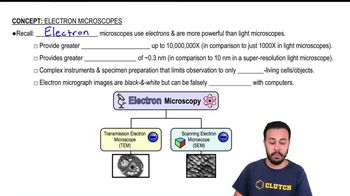
Electron Microscopes

Electron Wavelength and Resolution

The wavelength of electrons is much shorter than that of visible light, which allows electron microscopes to achieve much higher resolution. According to wave theory, shorter wavelengths enable the visualization of smaller structures, making electron microscopy ideal for detailed cellular and molecular imaging.
추천 영상:
가이드 코스
03:08
Electron Microscopes

Principle of Electron Wave Interference in Microscopy

In electron microscopy, electrons passing through or reflecting off a specimen create interference patterns due to their wave nature. These patterns are used to construct detailed images, as variations in electron wave phase and amplitude reveal structural information at the nanoscale.
추천 영상:
가이드 코스
03:08
Electron Microscopes