Ch. 6 - Microbial Nutrition and Growth
Bauman - Microbiology with Diseases by Taxonomy 6th Edition
Bauman6th EditionMicrobiology with Diseases by TaxonomyISBN: 9780134832302당신이 사용하는 게 아니라요?교과서 변경
6장, 문제 7

Draw and label the four distinct phases of a bacterial growth curve. Describe what is happening within the culture as it passes through the phases.

검증된 단계별 안내
1
Start by drawing a graph with the x-axis labeled as 'Time' and the y-axis labeled as 'Number of Bacteria (log scale)'. This sets the stage for visualizing bacterial growth over time.
Draw a curve that shows four distinct phases: Lag phase, Log (Exponential) phase, Stationary phase, and Death phase. Each phase should be clearly separated on the time axis.
Label the first phase as 'Lag phase'. Explain that during this phase, bacteria are metabolically active but not yet dividing rapidly. They are adapting to the new environment, synthesizing enzymes and molecules needed for growth.
Label the second phase as 'Log (Exponential) phase'. Describe that bacteria are dividing at a constant and rapid rate, leading to exponential growth. Nutrients are abundant, and waste products are minimal.
Label the third phase as 'Stationary phase'. Explain that the growth rate slows and stabilizes because nutrients become limited and waste products accumulate. The number of new cells equals the number of dying cells, so the population size remains constant.
Label the fourth phase as 'Death phase'. Describe that the number of dying cells exceeds the number of new cells due to depletion of nutrients and toxic accumulation, leading to a decline in the overall bacterial population.

비슷한 문제에 대한 검증된 영상 답변:

이 영상 해법은 위 문제에 도움이 된다고 튜터들이 추천한 것입니다.
영상 길이:
2m
도움이 되었나요?

주요 개념

질문에 올바르게 답하기 위해 반드시 이해해야 하는 핵심 개념들은 다음과 같습니다.

Phases of Bacterial Growth Curve

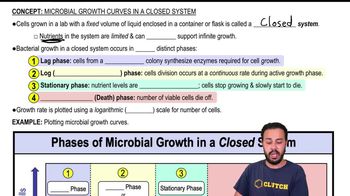
The bacterial growth curve consists of four phases: lag, log (exponential), stationary, and death. Each phase represents a different state of bacterial population dynamics in a closed culture system.
추천 영상:
08:59
Microbial Growth Curves in a Closed System

Lag Phase

During the lag phase, bacteria adapt to their new environment, synthesizing enzymes and molecules needed for growth. Cell division is minimal, but metabolic activity is high as cells prepare for rapid multiplication.
추천 영상:
05:15
Leading & Lagging DNA Strands

Log, Stationary, and Death Phases

In the log phase, bacteria divide rapidly, causing exponential population growth. The stationary phase occurs when nutrient depletion and waste accumulation halt growth, balancing cell division and death. Finally, in the death phase, cells die at an exponential rate due to unfavorable conditions.
추천 영상:
05:57
Phases of Glycolysis