Ch. 12 - Adaptive Immunity
Norman-McKay- Microbiology: Basic and Clinical Principles 2nd Edition
Norman-McKay2nd EditionMicrobiology: Basic and Clinical PrinciplesISBN: 9780137661619당신이 사용하는 게 아니라요?교과서 변경
8장, 문제 7

Which of the following does not generate long-term immunological memory? Select all that apply.
a. Antivenom
b. Antitoxins
c. Vaccinations
d. Breast-feeding
e. Antigens

검증된 단계별 안내
1
Step 1: Understand the concept of long-term immunological memory, which is the immune system's ability to remember a pathogen after initial exposure and respond more rapidly and effectively upon subsequent exposures. This memory is primarily generated by the activation of adaptive immunity, especially memory B and T cells.
Step 2: Analyze each option to determine if it involves the activation of adaptive immunity and the generation of memory cells. Vaccinations (option c) introduce antigens to stimulate this memory, so they do generate long-term immunological memory.
Step 3: Consider antivenoms (option a) and antitoxins (option b). These are preparations of antibodies given passively to neutralize toxins or venoms. Since they provide passive immunity, they do not stimulate the recipient's immune system to produce memory cells, so they do not generate long-term immunological memory.
Step 4: Evaluate breast-feeding (option d). Breast milk contains antibodies (mainly IgA) that provide passive immunity to the infant but do not induce the infant's immune system to develop memory cells, so it does not generate long-term immunological memory.
Step 5: Assess antigens (option e). Antigens themselves are substances that can trigger an immune response and are necessary for generating immunological memory. Therefore, antigens do contribute to long-term immunological memory.

비슷한 문제에 대한 검증된 영상 답변:

이 영상 해법은 위 문제에 도움이 된다고 튜터들이 추천한 것입니다.
영상 길이:
5m
도움이 되었나요?

주요 개념

질문에 올바르게 답하기 위해 반드시 이해해야 하는 핵심 개념들은 다음과 같습니다.

Long-term Immunological Memory

Long-term immunological memory is the immune system's ability to remember a pathogen after initial exposure, enabling a faster and stronger response upon re-exposure. This memory is primarily generated by memory B and T cells formed during adaptive immune responses, often triggered by infections or vaccinations.
추천 영상:
가이드 코스
03:15
5 Protein-Related Terms

Passive vs. Active Immunity

Active immunity involves the body's own immune response producing memory cells after exposure to an antigen, leading to long-term protection. Passive immunity, such as receiving antivenoms, antitoxins, or antibodies through breast milk, provides immediate but temporary protection without generating memory cells.
추천 영상:
가이드 코스
04:18
Passive vs. Active Transport

Role of Vaccinations and Antigens

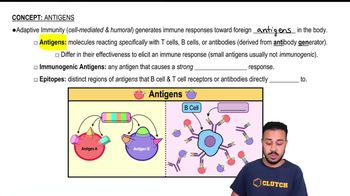
Vaccinations introduce antigens in a controlled way to stimulate active immunity and memory cell formation without causing disease. Antigens are substances that trigger immune responses, but by themselves do not generate memory unless presented in a way that activates adaptive immunity.
추천 영상: