뒤로
뒤로
문제 1
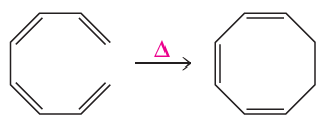
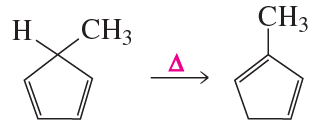
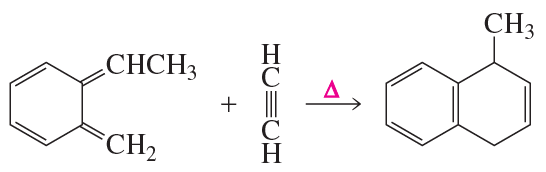
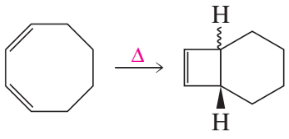
Examine the following pericyclic reactions. For each reaction, tell whether it is an electrocyclic reaction, a cycloaddition reaction, or a sigmatropic rearrangement.
a.
b.
c.
d.
문제 3
a. How many MOs does 1,3,5,7-octatetraene have?
b. What is the designation of its HOMO (c1, c2, etc.)?
c. How many nodes does its highest energy MO have between the nuclei?
문제 5
a. For conjugated systems with two, three, four, five, six, and seven conjugated p-bonds, construct quick MOs (just draw the lobes at the ends of the conjugated system as they are drawn on pages 1220 and 1221) to show whether the HOMO is symmetric or antisymmetric.
b. Using these drawings, convince yourself that the Woodward–Hoffmann rules in Table 28.1 are valid.
문제 6a,b
a. Under thermal conditions, will ring closure of (2E,4Z,6Z,8E)-2,4,6,8-decatetraene be conrotatory or disrotatory?
b. Will the product have the cis or the trans configuration?
문제 6c,d
c. Under photochemical conditions, will ring closure be conrotatory or disrotatory?
d. Will the product have the cis or the trans configuration?
문제 7a
Which of the following are correct? Correct any false statements.
a. A conjugated diene with an even number of double bonds undergoes conrotatory ring closure under thermal conditions.
문제 7b
Which of the following are correct? Correct any false statements.
b. A conjugated diene with an antisymmetric HOMO undergoes conrotatory ring closure under thermal conditions.
문제 7c
Which of the following are correct? Correct any false statements
c. A conjugated diene with an odd number of double bonds has a symmetric HOMO.
문제 8a(1)
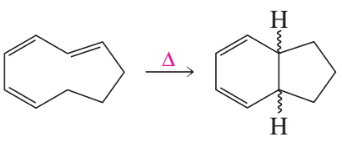
a. Identify the mode of ring closure for each of the following electrocyclic reactions
1.
문제 8a(2)
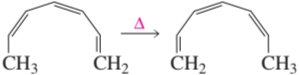
a. Identify the mode of ring closure for each of the following electrocyclic reactions
2.
문제 8b(1)
b. Are the indicated hydrogens cis or trans?
1.
문제 8b(2)
b. Are the indicated hydrogens cis or trans?
2.
문제 9
Compare the reaction between 2,4,6-cycloheptatrienone and cyclopentadiene to the reaction between 2,4,6-cycloheptatrienone and ethene. Why does 2,4,6-cycloheptatrienone use two electrons in one reaction and four electrons in the other?
a.
b.
문제 10
Explain why maleic anhydride reacts rapidly with 1,3-butadiene but does not react at all with ethene under thermal conditions.
문제 11
Will a concerted reaction take place between 1,3-butadiene and 2-cyclohexenone in the presence of ultraviolet light?
문제 12a(3)
a. Name the kind of sigmatropic rearrangement that occurs in each of the following reactions.
3.
문제 12a(4)
a. Name the kind of sigmatropic rearrangement that occurs in each of the following reactions.
4.
문제 12b(1,2)
b. Using arrows, show the electron rearrangement that takes place in each reaction.
1.
2.
문제 12b(4)
b. Using arrows, show the electron rearrangement that takes place in each reaction.
4.
문제 12b(3)
b. Using arrows, show the electron rearrangement that takes place in each reaction.
3.
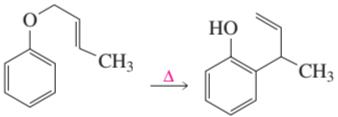
문제 13b
If the terminal sp2 carbon of the substituent attached to the benzene ring is labeled with 14C, where will the label be in the product?
문제 14
Why was a deuterated compound used in the last reaction on the preceding page?
문제 15
Account for the difference in the products obtained under photochemical and thermal conditions:
문제 16
Show how 5-methyl-1,3-cyclopentadiene rearranges to form 1-methyl-1,3-cyclopentadiene and 2-methyl-1,3-cyclopentadiene.
문제 17
Explain why [1,3] sigmatropic migrations of hydrogen cannot occur under thermal conditions, but [1,3] sigmatropic migrations of carbon can.
문제 18a
a. Will thermal 1,3-migrations of carbon occur with retention or inversion of configuration?
문제 18b
b. Will thermal 1,5-migrations of carbon occur with retention or inversion of configuration?
문제 19
Does the [1,7] sigmatropic rearrangement that converts provitamin D3 to vitamin D3 involve suprafacial or antarafacial rearrangement?
문제 20
Explain why the hydrogen and the methyl substituent are trans to one another after photochemical ring closure of provitamin D3 to form 7-dehydrocholesterol.
문제 21
Chorismate mutase is an enzyme that promotes a pericyclic reaction by forcing the substrate to assume the conformation needed for the reaction. The product of the pericyclic reaction is prephenate that is subsequently converted into the amino acids phenylalanine and tyrosine. What kind of a pericyclic reaction does chorismate mutase catalyze?