Ch. 28 - Pericyclic Reactions
Bruice - Organic Chemistry 8th Edition
Bruice8th EditionOrganic ChemistryISBN: 9780135213711당신이 사용하는 게 아니라요?교과서 변경
24장, 문제 18a

a. Will thermal 1,3-migrations of carbon occur with retention or inversion of configuration?

검증된 단계별 안내
1
Understand the concept of a 1,3-migration: A 1,3-migration involves the movement of a substituent (in this case, a carbon group) from one atom to another within a molecule, specifically over a distance of three atoms. This process often occurs under thermal conditions and involves a concerted mechanism.
Recognize the stereochemical implications: In a concerted reaction mechanism, the migration of the substituent and the reorganization of bonding orbitals occur simultaneously. This means that the stereochemistry of the migrating group is directly influenced by the orbital alignment during the transition state.
Analyze the orbital interactions: During a thermal 1,3-migration, the reaction typically proceeds through a suprafacial pathway (on the same face of the molecule) if the system has a favorable orbital overlap. This suprafacial migration leads to retention of configuration at the migrating carbon center.
Consider the Woodward-Hoffmann rules: These rules help predict the stereochemical outcome of pericyclic reactions. For a thermal 1,3-migration, the reaction follows the conservation of orbital symmetry, which supports retention of configuration for the migrating group.
Conclude the stereochemical outcome: Based on the concerted mechanism, orbital interactions, and the Woodward-Hoffmann rules, thermal 1,3-migrations of carbon occur with retention of configuration at the migrating carbon center.

비슷한 문제에 대한 검증된 영상 답변:

이 영상 해법은 위 문제에 도움이 된다고 튜터들이 추천한 것입니다.
영상 길이:
6m

주요 개념

질문에 올바르게 답하기 위해 반드시 이해해야 하는 핵심 개념들은 다음과 같습니다.

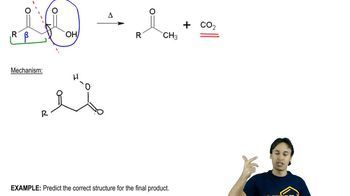
1,3-Migration Mechanism

1,3-migrations refer to the rearrangement of a substituent from one carbon atom to another that is three positions away in a molecule. This process often occurs in the context of rearrangements involving carbocations or radical intermediates. Understanding the mechanism is crucial for predicting the stereochemical outcome of the migration.
추천 영상:
04:32
General Mechanism

Retention vs. Inversion of Configuration

Retention and inversion of configuration describe how the spatial arrangement of atoms around a chiral center changes during a reaction. Retention means the configuration remains the same, while inversion indicates a switch in the arrangement. The stereochemical outcome of a migration can depend on the nature of the intermediates and the reaction conditions.
추천 영상:
02:14
The Electron Configuration

Thermal vs. Photochemical Reactions

Thermal reactions occur at elevated temperatures and typically involve the breaking and forming of bonds without the need for light. In contrast, photochemical reactions are driven by light energy. The conditions under which a 1,3-migration occurs can influence whether the reaction leads to retention or inversion of configuration, making it essential to consider the thermal context.
추천 영상:
09:36
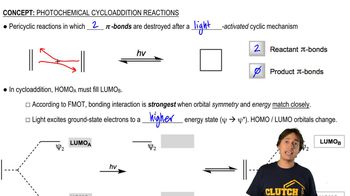
MO Theory of Photochemical Cycloadditions