Ch. 9 - Substitution and Elimination Reactions of Alkyl Halides
Bruice - Organic Chemistry 8th Edition
Bruice8th EditionOrganic ChemistryISBN: 9780135213711당신이 사용하는 게 아니라요?교과서 변경
9장, 문제 9a,b

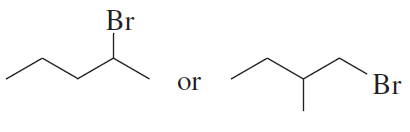
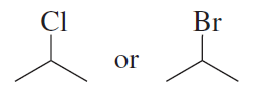
Which alkyl halide is more reactive in an SN2 reaction with a given nucleophile?
a. Two alkyl halide structures with bromine, questioning which is more reactive in an SN2 reaction.
b. Comparison of alkyl halides with chlorine and bromine for reactivity in an SN2 reaction.

검증된 단계별 안내
1
Step 1: Understand the SN2 reaction mechanism. SN2 reactions are bimolecular nucleophilic substitution reactions where the nucleophile attacks the electrophilic carbon and displaces the leaving group in a single step. The rate of the reaction depends on steric hindrance and the quality of the leaving group.
Step 2: Analyze the structures in part (a). The first structure has a primary alkyl bromide, while the second structure has a secondary alkyl bromide. Primary alkyl halides are less sterically hindered compared to secondary alkyl halides, making them more reactive in SN2 reactions.
Step 3: Analyze the structures in part (b). The first structure has a chlorine atom as the leaving group, while the second structure has an iodine atom. Iodine is a better leaving group than chlorine because it is larger and more polarizable, which stabilizes the negative charge after leaving.
Step 4: Compare the reactivity of the alkyl halides in part (a). The primary alkyl bromide is more reactive in an SN2 reaction than the secondary alkyl bromide due to reduced steric hindrance.
Step 5: Compare the reactivity of the alkyl halides in part (b). The alkyl iodide is more reactive in an SN2 reaction than the alkyl chloride because iodine is a superior leaving group compared to chlorine.

비슷한 문제에 대한 검증된 영상 답변:

이 영상 해법은 위 문제에 도움이 된다고 튜터들이 추천한 것입니다.
영상 길이:
4m

주요 개념

질문에 올바르게 답하기 위해 반드시 이해해야 하는 핵심 개념들은 다음과 같습니다.

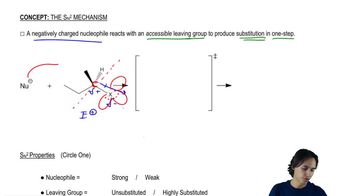
SN2 Mechanism

The SN2 (substitution nucleophilic bimolecular) mechanism involves a single concerted step where a nucleophile attacks an electrophile, leading to the simultaneous displacement of a leaving group. This reaction is characterized by a backside attack, which results in inversion of configuration at the carbon center. The rate of the reaction depends on both the nucleophile and the substrate, making it bimolecular.
추천 영상:
08:33
Drawing the SN2 Mechanism

Leaving Group Ability

The ability of a leaving group to depart from a substrate is crucial in determining the reactivity of alkyl halides in SN2 reactions. Good leaving groups, such as bromide (Br-) and iodide (I-), stabilize the negative charge after leaving, facilitating the reaction. In contrast, poor leaving groups, like chloride (Cl-), hinder the reaction, making the substrate less reactive.
추천 영상:
03:06
How to use the factors affecting acidity to predict leaving group ability.

Steric Hindrance

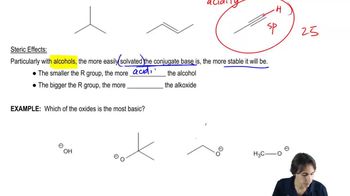
Steric hindrance refers to the spatial arrangement of atoms around a reactive center that can impede the approach of a nucleophile. In SN2 reactions, primary alkyl halides are more reactive than secondary or tertiary ones due to less steric hindrance. The presence of bulky groups around the electrophilic carbon can significantly slow down or prevent the nucleophilic attack.
추천 영상:
02:53
Understanding steric effects.