Ch. 18 - Ketones and Aldehydes
Wade - Organic Chemistry 9th Edition
Wade9th EditionOrganic ChemistryISBN: 9780135213728당신이 사용하는 게 아니라요?교과서 변경
18장, 문제 29a

Show how you would accomplish the following syntheses. You may use whatever additional reagents you need.
(a)

검증된 단계별 안내
1
Step 1: Analyze the transformation. The reaction involves converting an aldehyde group (-CHO) into a primary alcohol (-CH2OH) while retaining the ketone group in the cyclic structure.
Step 2: Identify the type of reaction. This is a reduction reaction, where the aldehyde is reduced to an alcohol. A common reagent for this transformation is sodium borohydride (NaBH4), which selectively reduces aldehydes and ketones.
Step 3: Select appropriate conditions. Sodium borohydride (NaBH4) is typically used in a protic solvent like ethanol or methanol to facilitate the reduction reaction.
Step 4: Write the reaction mechanism. The hydride ion (H-) from NaBH4 attacks the carbonyl carbon of the aldehyde, breaking the π bond and forming a tetrahedral intermediate. Protonation of the intermediate by the solvent leads to the formation of the primary alcohol.
Step 5: Verify the product. The ketone group remains intact, and the aldehyde is successfully converted into a primary alcohol, yielding the desired product.

비슷한 문제에 대한 검증된 영상 답변:

이 영상 해법은 위 문제에 도움이 된다고 튜터들이 추천한 것입니다.
영상 길이:
2m

주요 개념

질문에 올바르게 답하기 위해 반드시 이해해야 하는 핵심 개념들은 다음과 같습니다.

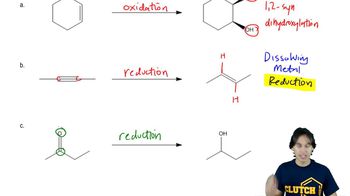
Oxidation and Reduction Reactions

In organic chemistry, oxidation refers to the loss of electrons or an increase in oxidation state, often involving the addition of oxygen or the removal of hydrogen. Conversely, reduction is the gain of electrons or a decrease in oxidation state, typically involving the addition of hydrogen or the removal of oxygen. Understanding these concepts is crucial for predicting the products of reactions, such as the conversion of an aldehyde to an alcohol.
추천 영상:
00:54
Distinguishing between Oxidation and Reduction

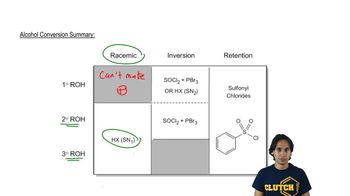
Aldehyde to Alcohol Conversion

The transformation of an aldehyde to an alcohol is a common reaction in organic synthesis, typically achieved through reduction. This can be accomplished using reducing agents like lithium aluminum hydride (LiAlH4) or sodium borohydride (NaBH4). Recognizing the functional groups involved and the appropriate reagents is essential for successfully carrying out this synthesis.
추천 영상:
04:30
Comparing and contrasting the Alcohol Conversions.

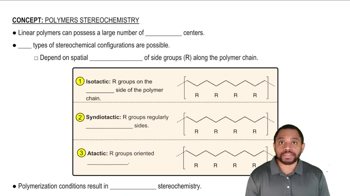
Stereochemistry and Isomerism

Stereochemistry involves the study of the spatial arrangement of atoms in molecules and how this affects their chemical behavior. In the context of the synthesis shown, understanding stereochemistry is important, especially if the product can exist as different isomers. This knowledge helps predict the properties and reactivity of the synthesized compound, which is vital for further applications in organic chemistry.
추천 영상:
가이드 코스
1:38
Polymer Stereochemistry Concept 1