뒤로
뒤로
문제 12b
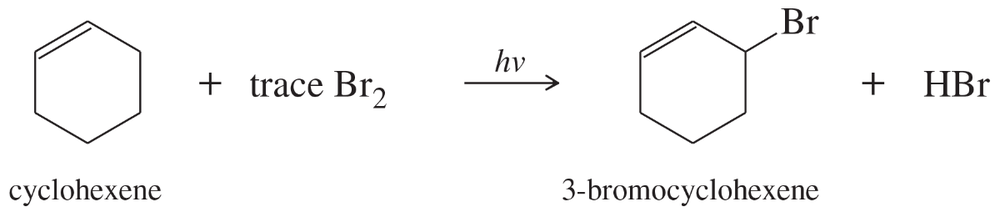
Under certain conditions, the bromination of cyclohexene follows an unusual rate law:
b. What is the kinetic order with respect to bromine?
문제 12c
Under certain conditions, the bromination of cyclohexene follows an unusual rate law:
c. What is the overall kinetic order?
문제 13a
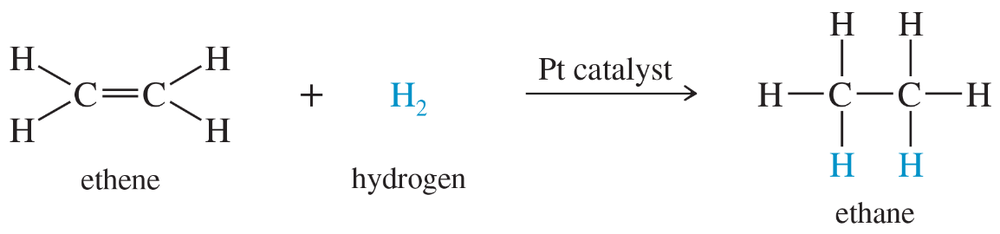
When a small piece of platinum is added to a mixture of ethene and hydrogen, the following reaction occurs: Ethene
Doubling the concentration of hydrogen has no effect on the reaction rate. Doubling the concentration of ethene also has no effect.
a. What is the kinetic order of this reaction with respect to ethene? With respect to hydrogen? What is the overall order?
문제 13b,c
When a small piece of platinum is added to a mixture of ethene and hydrogen, the following reaction occurs:
Doubling the concentration of hydrogen has no effect on the reaction rate. Doubling the concentration of ethene also has no effect.
b. Write the unusual rate equation for this reaction.
c. Explain this strange rate equation, and suggest what one might do to accelerate the reaction.
문제 14a
Draw the reaction-energy diagram for the following reverse reaction:
•CH3 + HCl → CH4 + Cl•
문제 14b,c
•CH3 + HCl → CH4 + Cl•
b. What is the activation energy for this reverse reaction?
c. What is the heat of reaction (ΔH°) for this reverse reaction?
문제 15a
Draw a reaction-energy diagram for the following reaction:
•CH3 + Cl2 → CH3Cl + Cl•
The activation energy is 4 kJ/mol (1 kcal/mol), and the overall ΔH° for the reaction is –110 kJ/mol (–27 kcal/mol).
문제 15b,c
•CH3 + Cl2 → CH3Cl + Cl•
The activation energy is 4 kJ/mol (1 kcal/mol), and the overall ΔH° for the reaction is –110 kJ/mol (–27 kcal/mol).
b. Give the equation for the reverse reaction.
c. What is the activation energy for the reverse reaction?
문제 16a,b
The bromination of methane proceeds through the following steps:
a. Draw a complete reaction-energy diagram for this reaction.
b. Label the rate-limiting step.
문제 16d
The bromination of methane proceeds through the following steps:
d. Compute the overall value of ΔH° for the bromination
문제 17a,b
a. Using the BDEs in Table 4-2 (page 167), compute the value of ΔH° for each step in the iodination of methane.
b. Compute the overall value of ΔH° for iodination.
문제 17c
Using the BDEs in Table 4-2 (page 167),
(c) Suggest two reasons why iodine does not react well with methane.
문제 18
What would be the product ratio in the chlorination of propane if all the hydrogens were abstracted at equal rates?
문제 19a,b
Classify each hydrogen atom in the following compounds as primary (1°), secondary (2°), or tertiary (3°).
a. butane
b. isobutane
문제 19c,d
Classify each hydrogen atom in the following compounds as primary (1°), secondary (2°), or tertiary (3°).
c. 2-methylbutane
d. cyclohexane
문제 19e
Classify each hydrogen atom in the following compounds as primary (1°), secondary (2°), or tertiary (3°).
e. norbornane (bicyclo[2.2.1]heptane)
문제 22b
Alkoxy radicals (R—O•) are generally more stable than alkyl (R•) radicals. Write an equation showing an alkyl free radical (from burning gasoline) abstracting a hydrogen atom from tert-butyl alcohol, (CH3)3COH. Explain why tert-butyl alcohol works as an antiknock additive for gasoline
문제 22c
Use the information in Table 4-2 to explain why toluene (PhCH3) has a very high octane rating of 111. Write an equation to show how toluene reacts with an alkyl free radical to give a relatively stable radical.
문제 25a
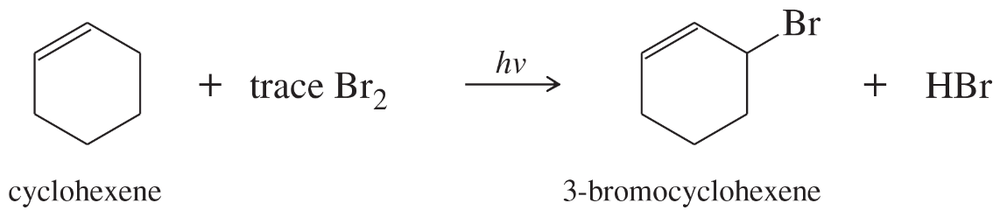
In the presence of a small amount of bromine, cyclohexene undergoes the following light-promoted reaction:
a. Propose a mechanism for this reaction.
문제 25b,c
In the presence of a small amount of bromine, cyclohexene undergoes the following light-promoted reaction:
b. Draw the structure of the rate-limiting transition state.
c. Use Hammond's postulate to predict which intermediate most closely resembles this transition state.
문제 27
Write an equation for the reaction of vitamin E with an oxidizing radical (RO•) to give ROH and a less reactive free radical.
문제 28
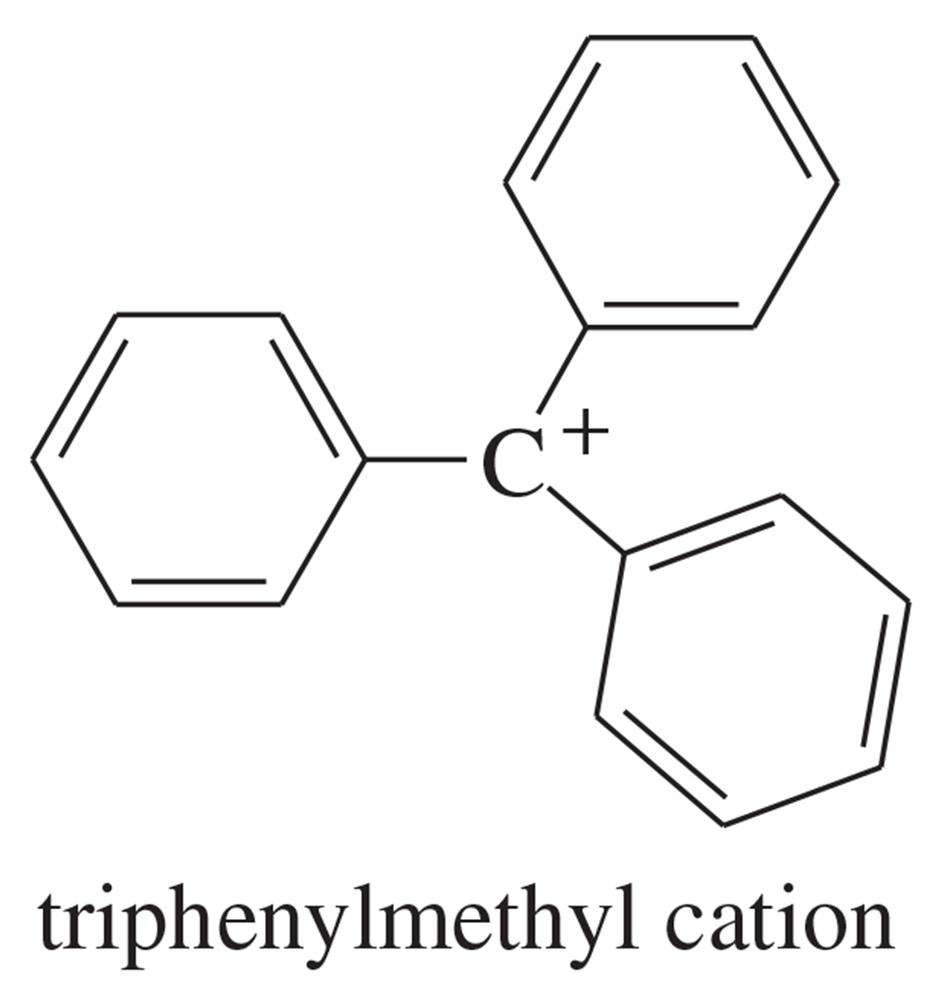
The triphenylmethyl cation is so stable that some of its salts can be stored for months. Explain why this cation is so stable.
문제 30
Rank the following radicals in decreasing order of stability. Classify each as primary, secondary, or tertiary.
a. The isopentyl radical,
b. The 3-methyl-2-butyl radical,
c. The 2-methyl-2-butyl radical,
d.
문제 31
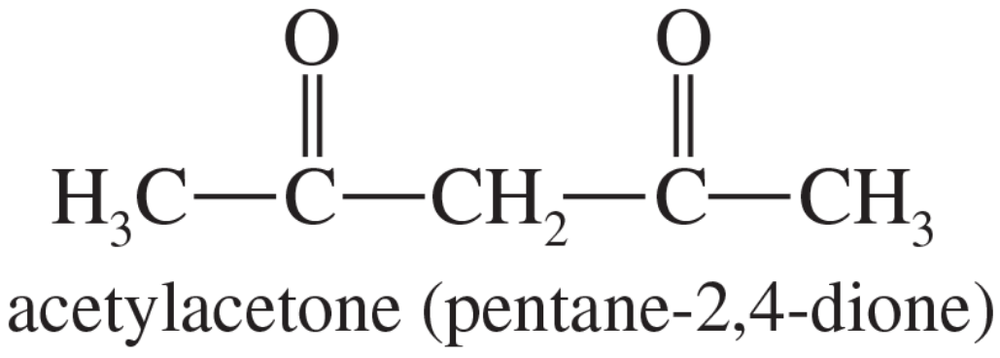
Acetylacetone (pentane-2,4-dione) reacts with sodium hydroxide to give water and the sodium salt of a carbanion. Write a complete structural formula for the carbanion, and use resonance forms to show the stabilization of the carbanion.
문제 32
Acetonitrile (CH3C≡N) is deprotonated by very strong bases. Write resonance forms to show the stabilization of the carbanion that results.
문제 33
When it is strongly heated, ethyl diazoacetate decomposes to give nitrogen gas and a carbene. Draw a Lewis structure of the carbene.
문제 34a
The following reaction is a common synthesis used in the organic chemistry laboratory course.
When we double the concentration of methoxide ion (CH3O–), we find that the reaction rate doubles. When we triple the concentration of 1-bromobutane, we find that the reaction rate triples.
a. What is the order of this reaction with respect to 1-bromobutane? What is the order with respect to methoxide ion? Write the rate equation for this reaction. What is the overall order?
문제 35
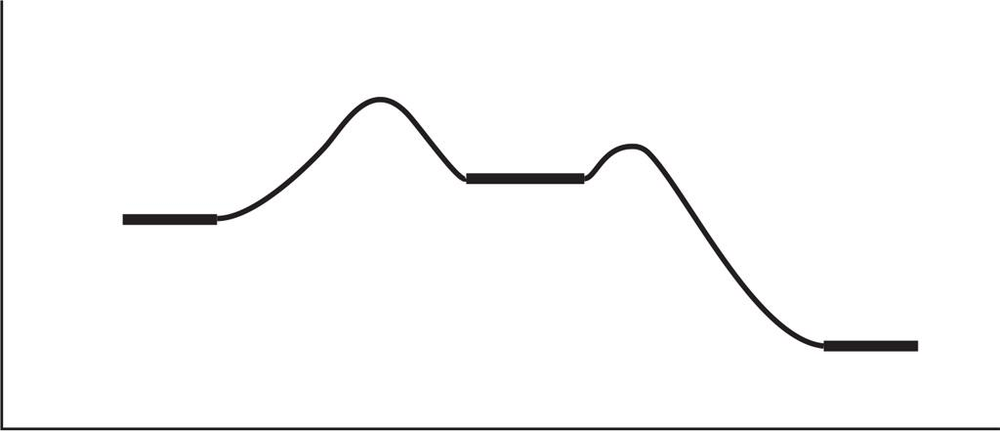
Consider the following reaction-energy diagram.
a. Label the reactants and the products. Label the activation energy for the first step and the second step.
b. Is the overall reaction endothermic or exothermic? What is the sign of ΔH°?
c. Which points in the curve correspond to intermediates? Which correspond to transition states?
d. Label the transition state of the rate-limiting step. Does its structure resemble the reactants, the products, or an intermediate?
문제 36
Draw a reaction-energy diagram for a one-step exothermic reaction. Label the parts that represent the reactants, products, transition state, activation energy, and heat of reaction.
문제 37
Draw a reaction-energy diagram for a two-step endothermic reaction with a rate-limiting second step.