뒤로
뒤로
문제 1a
Predict the major products of the following reactions, and propose mechanisms to support your predictions.
a. pent-1-ene + HCl
문제 1b
Predict the major products of the following reactions, and propose mechanisms to support your predictions.
b. 2-methylpropene + HCl
문제 2a
When 1 mole of buta-1,3-diene reacts with 1 mole of HBr, both 3-bromobut-1-ene and 1-bromobut-2-ene are formed. Propose a mechanism to account for this mixture of products.
문제 2b
When 1-chlorocyclohexene reacts with HBr, the major product is 1-bromo-1-chlorocyclohexane. Propose a mechanism for this reaction, and explain why your proposed intermediate is more stable than the other possible intermediate
문제 3b
Predict the major products of the following reactions, and propose mechanisms to support your predictions.
(b)
HINT: Remember to write out complete structures, including all bonds and charges, when writing a mechanism or determining the course of a reaction.
문제 4a,b
Show how you would accomplish the following synthetic conversions.
(a) but−1−ene → 1−bromobutane
(b) but−1−ene → 2−bromobutane
문제 4c
Show how you would accomplish the following synthetic conversions.
(c) 2−methylcyclohexanol → 1−bromo−1−methylcyclohexane
문제 4d
Show how you would accomplish the following synthetic conversions.
(d) 2−methylbutan-2-ol → 2-bromo-3-methylbutane
문제 5
Propose a mechanism to show how 3,3-dimethylbut-1-ene reacts with dilute aqueous H2SO4 to give 2,3-dimethylbutan-2-ol and a small amount of 2,3-dimethylbut-2-ene.
HINT: When predicting products for electrophilic additions, first draw the structure of the carbocation (or other intermediate) that results from electrophilic attack.
문제 6a
Predict the products of the following hydration reactions.
a. 1−methylcyclopentene + dilute acid
문제 6b,c
Predict the products of the following hydration reactions.
b. 2-phenylpropene + dilute acid
c. 1-phenylcyclohexene + dilute acid
문제 7
a. Propose a mechanism for the following reaction.
b. Give the structure of the product that results when this intermediate is reduced by sodium borohydride.
- Show how you would accomplish the following conversions. a. cis-hex-3-ene to meso-hexane-3,4-diol
문제 8
- Show how you would accomplish the following conversions. d. trans-hex-3-ene to (d,l)-hexane-3,4-diol
문제 8
문제 8a,b
Predict the major products of the following reactions.
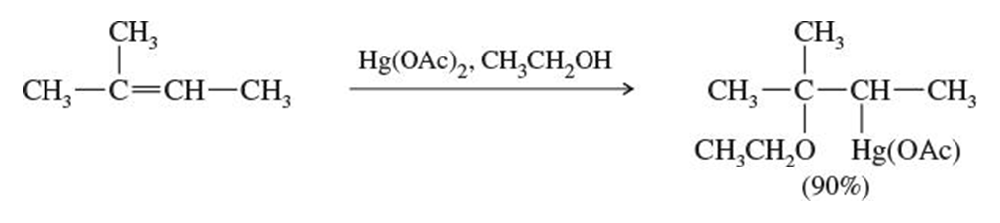
a. 1-methylcyclohexene+ aqueous Hg(OAc)2
b. the product from part (a), treated with NaBH4
문제 8c,d
Predict the major products of the following reactions.
c. 4−chlorocycloheptene + Hg(OAc)2 in CH3OH
d. the product from part (c), treated with NaBH4
문제 9a,b
Show how you would accomplish the following synthetic conversions.
a. but-1-ene → 2-methoxybutane
b. 1-iodo-2-methylcyclopentane → 1-methylcyclopentanol
문제 9c
Show how you would accomplish the following synthetic conversions.
c. 3-methylpent-1-ene → 3-methylpentan-2-ol
Explain why acid-catalyzed hydration would be a poor choice for the reaction in (c).
문제 10a,b
Predict the major products of the following reactions.
a. propene + BH3⋅THF
b. the product from part (a) + H2O2/OH−
문제 10c,d
Predict the major products of the following reactions.
(c) 2-methylpent-2-ene + BH3⋅THF
(d) the product from part (c) + H2O2/OH−
문제 11a
Show how you would accomplish the following synthetic conversions.
a. but-1-ene → butan-1-ol
문제 11b
Show how you would accomplish the following synthetic conversions.
(b) but-1-ene → butan-2-ol
문제 11c
Show how you would accomplish the following synthetic conversions.
c. 2-bromo-2,4-dimethylpentane → 2,4-dimethylpentan-3-ol
문제 12
In the hydroboration of 1-methylcyclopentene shown in Solved Problem 8-3, the reagents are achiral, and the products are chiral. The product is a racemic mixture of trans-2-methylcyclopentanol, but only one enantiomer is shown. Show how the other enantiomer is formed.
문제 13a
Predict the major products of the following reactions. Include stereochemistry where applicable.
(a) 1−methylcyclohexene + BH3⋅THF then H2O2, OH–
문제 13b
Predict the major products of the following reactions. Include stereochemistry where applicable.
(b) trans-4,4-dimethylpent-2-ene + BH3⋅THF then H2O2, OH–
문제 13c
Predict the major products of the following reactions. Include stereochemistry where applicable.
(c)
문제 14a
When (Z)-3-methylhex-3-ene undergoes hydroboration–oxidation, two isomeric products are formed. Give their structures, and label each asymmetric carbon atom as (R) or (S). What is the relationship between these isomers?
문제 14b
When (E)-3-methylhex-3-ene undergoes hydroboration–oxidation, two isomeric products are formed. Give their structures, and label each asymmetric carbon atom as (R) or (S). What is the relationship between these isomers? What is the relationship between the products formed from (Z)-3-methylhex-3-ene and those formed from (E)-3-methylhex-3-ene?
문제 15a
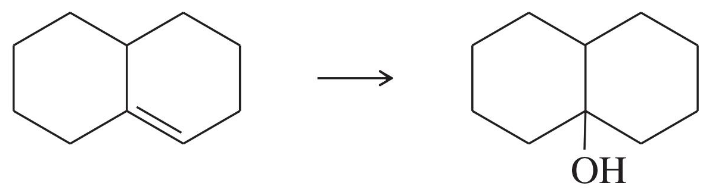
Show how you would accomplish the following transformations.
(a)