Ch.8 - Reactions of Alkenes
Wade - Organic Chemistry 9th Edition
Wade9th EditionOrganic ChemistryISBN: 9780135213728당신이 사용하는 게 아니라요?교과서 변경
8장, 문제 14b

When (E)-3-methylhex-3-ene undergoes hydroboration–oxidation, two isomeric products are formed. Give their structures, and label each asymmetric carbon atom as (R) or (S). What is the relationship between these isomers? What is the relationship between the products formed from (Z)-3-methylhex-3-ene and those formed from (E)-3-methylhex-3-ene?

검증된 단계별 안내
1
Step 1: Understand the reaction mechanism. Hydroboration–oxidation is a two-step reaction where an alkene reacts with borane (BH₃) or a borane derivative in the first step, followed by oxidation with hydrogen peroxide (H₂O₂) and hydroxide (OH⁻) in the second step. This reaction adds water (H and OH) across the double bond in a syn addition, meaning both groups are added to the same face of the alkene.
Step 2: Analyze the stereochemistry of the starting material. (E)-3-methylhex-3-ene has the substituents on opposite sides of the double bond. This stereochemistry will influence the orientation of the syn addition during hydroboration.
Step 3: Predict the products. The hydroboration–oxidation of (E)-3-methylhex-3-ene will yield two stereoisomeric alcohols due to the creation of a new chiral center at the carbon where the OH group is added. Draw the structures of the products, ensuring the syn addition is reflected in the stereochemistry.
Step 4: Assign R/S configuration to the chiral centers. Use the Cahn-Ingold-Prelog priority rules to determine the absolute configuration (R or S) of each asymmetric carbon atom in the products. Label each chiral center accordingly.
Step 5: Compare the relationships between the isomers and products. The two products formed from (E)-3-methylhex-3-ene are enantiomers (non-superimposable mirror images). For (Z)-3-methylhex-3-ene, the stereochemistry of the starting material leads to different products, which are also enantiomers. Compare the products from the (E)- and (Z)-isomers to determine their relationship, which is diastereomers (non-mirror image stereoisomers).

비슷한 문제에 대한 검증된 영상 답변:

이 영상 해법은 위 문제에 도움이 된다고 튜터들이 추천한 것입니다.
영상 길이:
18m
도움이 되었나요?

주요 개념

질문에 올바르게 답하기 위해 반드시 이해해야 하는 핵심 개념들은 다음과 같습니다.

Hydroboration-Oxidation

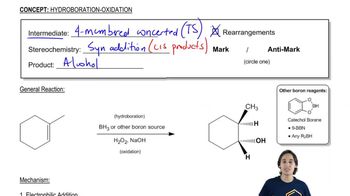
Hydroboration-oxidation is a two-step reaction that converts alkenes into alcohols. In the first step, borane (BH3) adds across the double bond of the alkene, resulting in a trialkylborane intermediate. The second step involves oxidation with hydrogen peroxide (H2O2) in a basic solution, leading to the formation of an alcohol. This reaction is stereospecific and leads to anti-Markovnikov addition, which is crucial for understanding the product distribution.
추천 영상:
06:38
General properties of hydroboration-oxidation.

Stereochemistry and Chiral Centers

Stereochemistry refers to the spatial arrangement of atoms in molecules and how this affects their chemical behavior. Chiral centers, typically carbon atoms bonded to four different substituents, can exist in two configurations, designated as (R) or (S) based on the Cahn-Ingold-Prelog priority rules. Identifying these configurations is essential for determining the specific isomers produced in reactions, especially when dealing with compounds that have multiple chiral centers.
추천 영상:
가이드 코스
1:38
Polymer Stereochemistry Concept 1

Isomerism and Relationship Between Isomers

Isomerism occurs when two or more compounds have the same molecular formula but different structural or spatial arrangements. In the context of the question, the isomers formed from (E)-3-methylhex-3-ene and (Z)-3-methylhex-3-ene are diastereomers, which are non-mirror image stereoisomers. Understanding the relationship between these isomers is important for predicting their reactivity and properties, as well as for determining how they relate to each other in terms of stability and synthesis.
추천 영상:
01:54
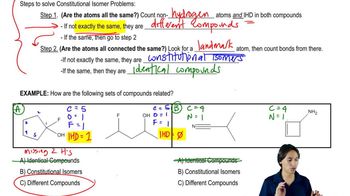
Isomeric Relationships