


Ch.8 - Reactions of Alkenes
Wade - Organic Chemistry 9th Edition
Wade9th EditionOrganic ChemistryISBN: 9780135213728당신이 사용하는 게 아니라요?교과서 변경
8장, 문제 15a

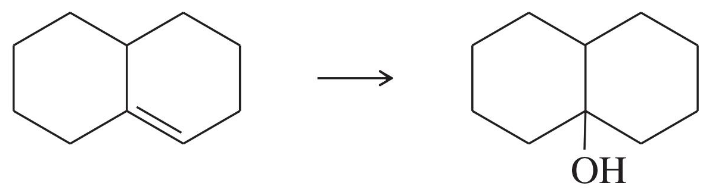
Show how you would accomplish the following transformations.
(a)

검증된 단계별 안내
1
Step 1: Analyze the starting material and the product. The starting material is a bicyclic compound with a double bond, and the product is a bicyclic alcohol. This suggests that the transformation involves the addition of a hydroxyl group (-OH) to the double bond.
Step 2: Recognize that this transformation is likely an anti-Markovnikov addition of water to the double bond. Anti-Markovnikov hydration can be achieved using hydroboration-oxidation. The reagents required are BH₃·THF (borane in tetrahydrofuran) followed by H₂O₂ (hydrogen peroxide) and NaOH (sodium hydroxide).
Step 3: In the first step of hydroboration, BH₃·THF adds to the double bond in a syn addition manner, forming an organoborane intermediate. The boron atom attaches to the less substituted carbon of the double bond, ensuring anti-Markovnikov regioselectivity.
Step 4: In the second step, the organoborane intermediate is oxidized using H₂O₂ and NaOH. This replaces the boron atom with a hydroxyl group (-OH), resulting in the formation of the alcohol product.
Step 5: Since the product is chiral, the reaction produces a racemic mixture (both enantiomers) due to the formation of a new stereocenter during the addition of the hydroxyl group.

비슷한 문제에 대한 검증된 영상 답변:

이 영상 해법은 위 문제에 도움이 된다고 튜터들이 추천한 것입니다.
영상 길이:
10m

주요 개념

질문에 올바르게 답하기 위해 반드시 이해해야 하는 핵심 개념들은 다음과 같습니다.

Nucleophilic Addition

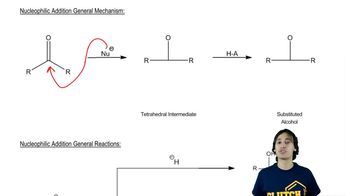
Nucleophilic addition is a fundamental reaction mechanism in organic chemistry where a nucleophile attacks an electrophilic carbon atom, leading to the formation of a new bond. In the context of the transformation shown, a nucleophile, such as water or an alcohol, can add to a double bond or a carbonyl group, resulting in the formation of an alcohol. Understanding this mechanism is crucial for predicting the products of reactions involving unsaturated compounds.
추천 영상:
08:27
Nucleophilic Addition

Stereochemistry

Stereochemistry refers to the study of the spatial arrangement of atoms in molecules and how this affects their chemical behavior. In the transformation depicted, the stereochemistry of the starting material and the product can influence the reaction pathway and the final product's properties. Recognizing the stereochemical implications is essential for understanding how different isomers can form and their reactivity.
추천 영상:
가이드 코스
1:38
Polymer Stereochemistry Concept 1

Functional Group Transformation

Functional group transformation involves changing one functional group into another through chemical reactions. In the given transformation, a double bond is converted into an alcohol functional group, showcasing how organic compounds can be modified to achieve desired properties. Mastery of functional group transformations is vital for synthetic organic chemistry, allowing chemists to design and create complex molecules.
추천 영상:
02:36
Identifying Functional Groups