Ch. 03 - Kinematics in Two or Three Dimensions; Vectors
Giancoli Douglas - Physics for Scientists and Engineers 5th edition
Giancoli Douglas5th editionPhysics for Scientists and EngineersISBN: 9780137488179당신이 사용하는 게 아니라요?교과서 변경
3장, 문제 10

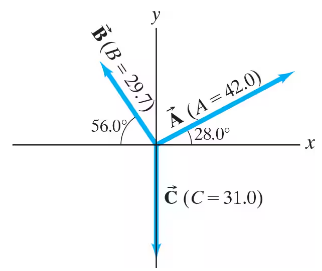
Three vectors are shown in Fig. 3–41. Their magnitudes are given in arbitrary units. Determine the sum of the three vectors. Give the resultant in terms of (a) components, (b) magnitude and angle with the +𝓍 axis. 

검증된 단계별 안내
1
Identify the components of each vector. For each vector, break it into its x and y components using trigonometry. Use the formulas: x-component = magnitude × cos(θ) and y-component = magnitude × sin(θ), where θ is the angle the vector makes with the +x axis.
Sum the x-components of all three vectors to find the resultant x-component (Rₓ). Similarly, sum the y-components of all three vectors to find the resultant y-component (Rᵧ). Use the equations: Rₓ = Σx-components and Rᵧ = Σy-components.
To find the magnitude of the resultant vector, use the Pythagorean theorem: magnitude = √(Rₓ² + Rᵧ²).
Determine the angle of the resultant vector with respect to the +x axis using the formula: θ = tan⁻¹(Rᵧ / Rₓ). Ensure you consider the signs of Rₓ and Rᵧ to place the angle in the correct quadrant.
Combine the results to express the resultant vector in terms of its magnitude and angle, as well as its components (Rₓ and Rᵧ).

주요 개념

질문에 올바르게 답하기 위해 반드시 이해해야 하는 핵심 개념들은 다음과 같습니다.

Vector Addition

Vector addition involves combining two or more vectors to determine a resultant vector. This can be done graphically by placing the tail of one vector at the head of another or mathematically by adding their components. The resultant vector represents the cumulative effect of the individual vectors in both magnitude and direction.
추천 영상:
가이드 코스
07:30
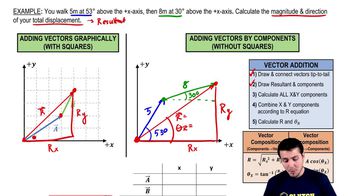
Vector Addition By Components

Components of a Vector

Vectors can be broken down into their components along the coordinate axes, typically the x and y axes in two-dimensional space. The x-component represents the horizontal influence, while the y-component represents the vertical influence. This decomposition simplifies calculations, allowing for easier addition and analysis of vectors.
추천 영상:
가이드 코스
07:30
Vector Addition By Components

Magnitude and Direction

The magnitude of a vector is its length, representing the size or strength of the vector, while the direction indicates the vector's orientation in space. The angle with respect to a reference axis, such as the +x axis, is often used to describe the direction. Understanding both magnitude and direction is essential for fully characterizing a vector's effect in a physical context.
추천 영상:
가이드 코스
03:59
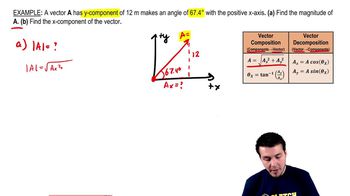
Calculating Magnitude & Components of a Vector