Ch. 03 - Kinematics in Two or Three Dimensions; Vectors
Giancoli Douglas - Physics for Scientists and Engineers 5th edition
Giancoli Douglas5th editionPhysics for Scientists and EngineersISBN: 9780137488179당신이 사용하는 게 아니라요?교과서 변경
3장, 문제 13b

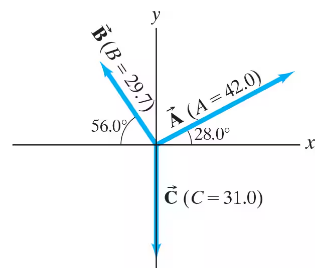
For the vectors shown in Fig. 3–41, determine 2 A - 3 B + 2 C.
3

검증된 단계별 안내
1
Step 1: Understand the problem. You are tasked with finding the resultant vector from the expression 2A - 3B + 2C, where A, B, and C are vectors. Refer to Fig. 3–41 for the components or directions of these vectors.
Step 2: Break each vector (A, B, and C) into its components. For example, if vector A has components Ax and Ay, write A as A = (Ax, Ay). Do the same for vectors B and C.
Step 3: Multiply each vector by its respective scalar. For instance, multiply vector A by 2 to get 2A = (2Ax, 2Ay). Similarly, calculate -3B = (-3Bx, -3By) and 2C = (2Cx, 2Cy).
Step 4: Add the components of the scaled vectors together. For the x-components, compute: (2Ax) + (-3Bx) + (2Cx). For the y-components, compute: (2Ay) + (-3By) + (2Cy).
Step 5: Combine the results from Step 4 to express the resultant vector in component form as R = (Rx, Ry), where Rx is the sum of the x-components and Ry is the sum of the y-components. If needed, you can also find the magnitude and direction of the resultant vector using the formulas: |R| = sqrt(Rx^2 + Ry^2) and θ = arctan(Ry/Rx).

주요 개념

질문에 올바르게 답하기 위해 반드시 이해해야 하는 핵심 개념들은 다음과 같습니다.

Vector Addition

Vector addition is the process of combining two or more vectors to produce a resultant vector. This involves adding the corresponding components of the vectors, which can be visualized graphically by placing the tail of one vector at the head of another. The resultant vector represents the cumulative effect of the individual vectors in both magnitude and direction.
추천 영상:
가이드 코스
07:30
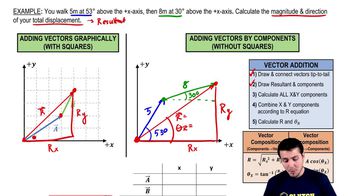
Vector Addition By Components

Scalar Multiplication

Scalar multiplication involves multiplying a vector by a scalar (a real number), which scales the vector's magnitude without changing its direction. For example, multiplying a vector by 2 doubles its length, while multiplying by -1 reverses its direction. This concept is essential when manipulating vectors in expressions like 2A or -3B.
추천 영상:
가이드 코스
04:06
Introduction to Vectors and Scalars

Linear Combination of Vectors

A linear combination of vectors involves creating a new vector by multiplying each vector by a scalar and then adding the results. In the expression 2A - 3B + 2C, each vector A, B, and C is scaled by its respective coefficient, and the resulting vectors are summed. This concept is fundamental in vector spaces and is used to express complex vector relationships.
추천 영상:
가이드 코스
07:31
Linear Thermal Expansion