Ch. 40 - Molecules and Solids
Giancoli Douglas - Physics for Scientists and Engineers 5th edition
Giancoli Douglas5th editionPhysics for Scientists and EngineersISBN: 9780137488179당신이 사용하는 게 아니라요?교과서 변경
37장, 문제 54

(II) An ac voltage of 120 V rms is to be rectified. Estimate very roughly the average current in the output resistor R (42 kΩ) for (a) a half-wave rectifier (Fig. 40–39), and (b) a full-wave rectifier (Fig. 40–40) without capacitor.

검증된 단계별 안내
1
Step 1: Understand the problem. The goal is to estimate the average current through the resistor R (42 kΩ) for two cases: (a) a half-wave rectifier and (b) a full-wave rectifier. The input voltage is given as 120 V rms, and we are working without a capacitor.
Step 2: Convert the rms voltage to peak voltage. The relationship between rms voltage (V_rms) and peak voltage (V_peak) is given by: Vpeak=Vrms×2. Substitute 120 V for V_rms to find V_peak.
Step 3: For the half-wave rectifier, the average output voltage is approximately half of the peak voltage. Use the formula: Vavg=Vpeak/2. Then, calculate the average current using Ohm's Law: Iavg=Vavg/R, where R = 42 kΩ.
Step 4: For the full-wave rectifier, the average output voltage is approximately equal to the peak voltage. Use the formula: Vavg=Vpeak. Then, calculate the average current using Ohm's Law: Iavg=Vavg/R, where R = 42 kΩ.
Step 5: Compare the results for the half-wave and full-wave rectifiers. Note that the full-wave rectifier provides a higher average current because it utilizes both halves of the AC cycle, while the half-wave rectifier only uses one half.

비슷한 문제에 대한 검증된 영상 답변:

이 영상 해법은 위 문제에 도움이 된다고 튜터들이 추천한 것입니다.
영상 길이:
7m
도움이 되었나요?

주요 개념

질문에 올바르게 답하기 위해 반드시 이해해야 하는 핵심 개념들은 다음과 같습니다.

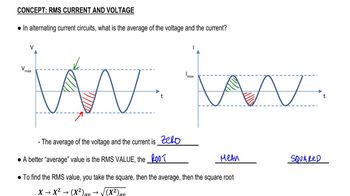
RMS Voltage

RMS (Root Mean Square) voltage is a statistical measure of the magnitude of a varying voltage. It represents the equivalent DC voltage that would deliver the same power to a resistor. For an AC voltage, the RMS value is calculated as the peak voltage divided by the square root of 2, which is essential for determining the effective voltage in circuits.
추천 영상:
가이드 코스
07:14
RMS Current and Voltage

Rectification

Rectification is the process of converting alternating current (AC) to direct current (DC). In half-wave rectification, only one half of the AC waveform is allowed to pass, resulting in a pulsating DC output. Full-wave rectification, on the other hand, utilizes both halves of the AC waveform, providing a smoother and more efficient DC output, which is crucial for understanding the average current in the output resistor.

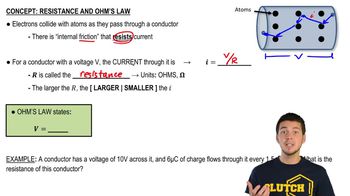
Ohm's Law

Ohm's Law states that the current (I) flowing through a conductor between two points is directly proportional to the voltage (V) across the two points and inversely proportional to the resistance (R) of the conductor. This relationship is expressed as I = V/R, which is fundamental for calculating the average current in the output resistor for both half-wave and full-wave rectifiers.
추천 영상:
가이드 코스
03:07
Resistance and Ohm's Law