
Ch. 40 - Molecules and Solids
Giancoli Douglas - Physics for Scientists and Engineers 5th edition
Giancoli Douglas5th editionPhysics for Scientists and EngineersISBN: 9780137488179당신이 사용하는 게 아니라요?교과서 변경
37장, 문제 61

If the current gain of the transistor amplifier in Fig. 40–49 is β = ic/iB = 95, what value must Rc have if a 1.0-μA ac base current is to produce an ac output voltage of 0.40 V?

검증된 단계별 안내
1
Identify the relationship between the base current (iB), collector current (iC), and the current gain (β). The formula is: icC=β×iBB. Use this to calculate the collector current.
Determine the relationship between the output voltage (Vout), the collector current (iC), and the collector resistor (Rc). The formula is: Voutout=iCC×Rcc. Rearrange this equation to solve for Rc: Rcc=VoutoutiCC.
Substitute the given values into the formula for iC. Use β=95 and iBB=1.0µA to calculate iCC.
Substitute the calculated value of iC and the given output voltage Voutout=0.40V into the formula for Rc to find its value.
Verify the units of Rc to ensure they are consistent (ohms, Ω). Double-check the calculations to confirm the result is reasonable and matches the problem's requirements.

비슷한 문제에 대한 검증된 영상 답변:

이 영상 해법은 위 문제에 도움이 된다고 튜터들이 추천한 것입니다.
영상 길이:
2m
도움이 되었나요?

주요 개념

질문에 올바르게 답하기 위해 반드시 이해해야 하는 핵심 개념들은 다음과 같습니다.

Transistor Current Gain (β)

The current gain of a transistor, denoted as β (beta), is the ratio of the collector current (ic) to the base current (iB). It indicates how effectively a transistor can amplify current; a higher β means greater amplification. In this question, β = 95 implies that for every 1 μA of base current, the collector current will be 95 μA, which is crucial for determining the output voltage.
추천 영상:
가이드 코스
05:38
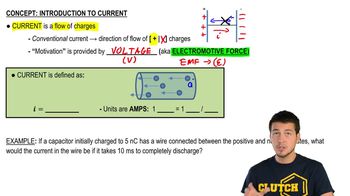
Intro to Current

Output Voltage (Vout)

The output voltage in a transistor amplifier is the voltage across the load resistor (Rc) due to the amplified collector current. It is calculated using Ohm's Law (V = IR), where I is the collector current. In this scenario, the desired output voltage is 0.40 V, which must be achieved by selecting an appropriate value for Rc based on the amplified current from the base input.
추천 영상:
가이드 코스
07:14
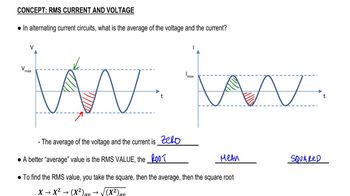
RMS Current and Voltage

Load Resistor (Rc)

The load resistor (Rc) in a transistor circuit is connected to the collector and is essential for converting the amplified current into a usable output voltage. The value of Rc directly affects the output voltage; a higher Rc will result in a higher output voltage for a given collector current. To find the correct Rc value, one must consider the relationship between the collector current, the desired output voltage, and Ohm's Law.
추천 영상:
가이드 코스
04:11
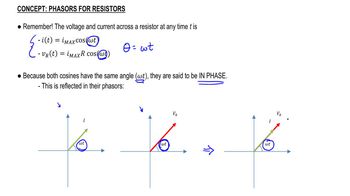
Phasors for Resistors