Ch 01: Concepts of Motion
Knight Calc - Physics for Scientists and Engineers 5th Edition
Knight Calc5th EditionPhysics for Scientists and EngineersISBN: 9780137344796당신이 사용하는 게 아니라요?교과서 변경
1장, 문제 9

FIGURE EX1.9 shows five points of a motion diagram. Use Tactics Box 1.2 to find the average acceleration vectors at points 1, 2, and 3. Draw the completed motion diagram showing velocity vectors and acceleration vectors.

검증된 단계별 안내
1
Step 1: Understand the problem. The motion diagram shows the positions of an object at different times. To find the average acceleration vectors at points 1, 2, and 3, we need to calculate the change in velocity over the change in time between consecutive points. Acceleration is a vector quantity, so direction matters.
Step 2: Calculate the average acceleration at point 1. Use the formula: a=vt. Find the velocity vectors at points 1 and 2 by analyzing the displacement between these points and dividing by the time interval. Then, compute the change in velocity (v) and divide by the time interval (t).
Step 3: Calculate the average acceleration at point 2. Repeat the process for points 2 and 3. Determine the velocity vectors at points 2 and 3, calculate the change in velocity, and divide by the time interval to find the average acceleration vector at point 2.
Step 4: Calculate the average acceleration at point 3. Follow the same procedure for points 3 and 4. Determine the velocity vectors at points 3 and 4, calculate the change in velocity, and divide by the time interval to find the average acceleration vector at point 3.
Step 5: Draw the completed motion diagram. Represent the velocity vectors at each point as arrows tangent to the path of motion, with their lengths proportional to the magnitude of the velocity. Draw the acceleration vectors at points 1, 2, and 3 as arrows pointing in the direction of the average acceleration, with their lengths proportional to the magnitude of the acceleration. Ensure the diagram clearly shows the relationship between velocity and acceleration vectors.

비슷한 문제에 대한 검증된 영상 답변:

이 영상 해법은 위 문제에 도움이 된다고 튜터들이 추천한 것입니다.
영상 길이:
3m
도움이 되었나요?

주요 개념

질문에 올바르게 답하기 위해 반드시 이해해야 하는 핵심 개념들은 다음과 같습니다.

Average Acceleration

Average acceleration is defined as the change in velocity over a specified time interval. It is a vector quantity, meaning it has both magnitude and direction. To calculate average acceleration, you subtract the initial velocity from the final velocity and divide by the time taken for that change. This concept is crucial for understanding how an object's speed and direction change over time.
추천 영상:
가이드 코스
05:44
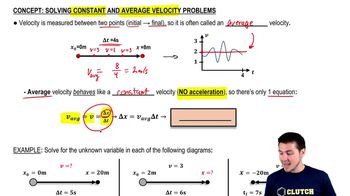
Solving Constant and Average Velocity Problems

Motion Diagrams

Motion diagrams are visual representations that illustrate an object's position, velocity, and acceleration at various points in time. Each point in the diagram corresponds to a specific moment, showing how the object's motion evolves. By analyzing these diagrams, one can gain insights into the dynamics of the motion, including the relationships between position, velocity, and acceleration.
추천 영상:
가이드 코스
08:07
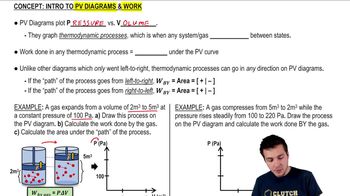
Work and PV Diagrams

Vector Representation

Vectors are mathematical entities that have both magnitude and direction, making them essential for representing physical quantities like velocity and acceleration. In motion diagrams, velocity vectors indicate the speed and direction of an object's movement, while acceleration vectors show how the velocity changes. Understanding vector representation is vital for accurately interpreting and drawing motion diagrams, as it allows for a clear depiction of the forces acting on an object.
추천 영상:
가이드 코스
06:44
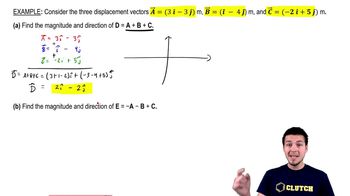
Adding 3 Vectors in Unit Vector Notation