Ch 01: Concepts of Motion
Knight Calc - Physics for Scientists and Engineers 5th Edition
Knight Calc5th EditionPhysics for Scientists and EngineersISBN: 9780137344796당신이 사용하는 게 아니라요?교과서 변경
1장, 문제 49a

Problems 49, 50, 51, and 52 show a partial motion diagram. For each: Complete the motion diagram by adding acceleration vectors.

검증된 단계별 안내
1
Analyze the given motion diagram to determine the type of motion (e.g., constant velocity, acceleration, or deceleration). Look at the spacing between the position markers to infer whether the object is speeding up, slowing down, or moving at a constant speed.
Recall that acceleration vectors indicate the rate of change of velocity. If the object is speeding up, the acceleration vector points in the same direction as the velocity. If the object is slowing down, the acceleration vector points opposite to the velocity.
For each segment of the motion diagram, identify the direction of the velocity vector. This is typically indicated by the direction of motion (e.g., left to right or right to left).
Draw the acceleration vectors at each position marker. Ensure the vectors are proportional to the rate of change of velocity. For example, if the object is accelerating uniformly, the acceleration vectors should have the same magnitude and direction throughout.
Double-check your completed motion diagram to ensure that the acceleration vectors are consistent with the observed changes in velocity and the type of motion (e.g., uniform acceleration, deceleration, or constant velocity with no acceleration).

비슷한 문제에 대한 검증된 영상 답변:

이 영상 해법은 위 문제에 도움이 된다고 튜터들이 추천한 것입니다.
영상 길이:
1m
도움이 되었나요?

주요 개념

질문에 올바르게 답하기 위해 반드시 이해해야 하는 핵심 개념들은 다음과 같습니다.

Motion Diagrams

Motion diagrams are visual representations that depict the position of an object at various points in time. They typically include vectors that represent velocity and acceleration, helping to illustrate how an object's motion changes over time. Understanding these diagrams is crucial for analyzing the dynamics of moving objects.
추천 영상:
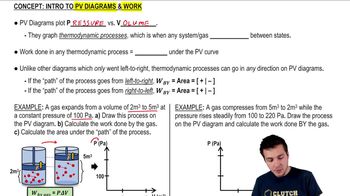
08:07
Work and PV Diagrams

Acceleration Vectors

Acceleration vectors indicate the rate of change of velocity of an object. They are represented as arrows pointing in the direction of the acceleration, with their length proportional to the magnitude of the acceleration. Recognizing how to add these vectors to a motion diagram is essential for accurately depicting the forces acting on an object.
추천 영상:
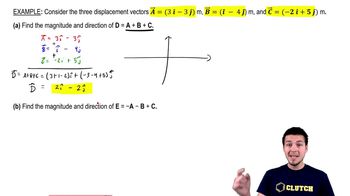
06:44
Adding 3 Vectors in Unit Vector Notation

Kinematics

Kinematics is the branch of physics that deals with the motion of objects without considering the forces that cause the motion. It involves concepts such as displacement, velocity, and acceleration, which are fundamental for analyzing motion diagrams. A solid grasp of kinematics is necessary to complete the motion diagrams accurately.
추천 영상:
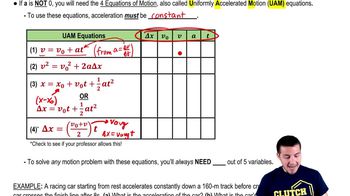
08:25
Kinematics Equations