Ch 02: Kinematics in One Dimension
Knight Calc - Physics for Scientists and Engineers 5th Edition
Knight Calc5th EditionPhysics for Scientists and EngineersISBN: 9780137344796당신이 사용하는 게 아니라요?교과서 변경
2장, 문제 38b

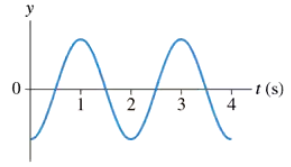
A block is suspended from a spring, pulled down, and released. The block's position-versus-time graph is shown in FIGURE P2.38. Draw a reasonable velocity-versus-time graph.

검증된 단계별 안내
1
Analyze the position-versus-time graph provided. The graph shows a sinusoidal motion, indicating simple harmonic motion (SHM). The block oscillates around the equilibrium position (x = 0) with a periodic pattern.
Recall that velocity is the derivative of position with respect to time. For SHM, if the position x(t) is represented as a sine function, the velocity v(t) will be represented as a cosine function, but with a phase shift of π/2 radians (90 degrees).
Identify key points on the position graph: where the slope is zero (maximum or minimum position), the velocity will be zero. Where the slope is steepest (crossing the equilibrium position), the velocity will be at its maximum magnitude.
Sketch the velocity-versus-time graph. At t = 0, the position graph starts at a maximum, so the velocity graph will start at zero and decrease (negative slope). As the position decreases to zero, the velocity reaches its maximum negative value. When the position reaches a minimum, the velocity returns to zero, and so on.
Ensure the velocity graph is also sinusoidal but shifted by π/2 radians relative to the position graph. The amplitude of the velocity graph will depend on the angular frequency ω and the amplitude of the position graph, as v_max = ω * A.

비슷한 문제에 대한 검증된 영상 답변:

이 영상 해법은 위 문제에 도움이 된다고 튜터들이 추천한 것입니다.
영상 길이:
6m
도움이 되었나요?

주요 개념

질문에 올바르게 답하기 위해 반드시 이해해야 하는 핵심 개념들은 다음과 같습니다.

Simple Harmonic Motion (SHM)

Simple Harmonic Motion is a type of periodic motion where an object oscillates around an equilibrium position. The motion is characterized by a restoring force proportional to the displacement from the equilibrium, leading to sinusoidal position, velocity, and acceleration graphs. In the context of a block on a spring, SHM describes how the block moves back and forth after being displaced.
추천 영상:
가이드 코스
07:52
Simple Harmonic Motion of Pendulums

Velocity-Time Graphs

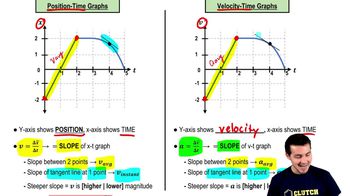
A velocity-time graph represents the velocity of an object as a function of time. The slope of this graph indicates acceleration, while the area under the curve represents displacement. For a block undergoing SHM, the velocity graph will be sinusoidal, with maximum velocity at the equilibrium position and zero velocity at the maximum displacement points.
추천 영상:
가이드 코스
05:59
Velocity-Time Graphs & Acceleration

Phase Relationship between Position and Velocity

In SHM, there is a specific phase relationship between position and velocity. When the position is at its maximum (the block is at rest), the velocity is zero. Conversely, when the position is zero (the block passes through the equilibrium), the velocity reaches its maximum. This relationship is crucial for accurately drawing the velocity-time graph based on the given position-time graph.
추천 영상:
가이드 코스
03:43
Relationships Between Force, Field, Energy, Potential