Ch 02: Kinematics in One Dimension
Knight Calc - Physics for Scientists and Engineers 5th Edition
Knight Calc5th EditionPhysics for Scientists and EngineersISBN: 9780137344796당신이 사용하는 게 아니라요?교과서 변경
2장, 문제 36a

The position of a particle is given by the function x = (2t3 = 6t2 + 12) m, where t is in s. At what time does the particle reach its minimum velocity? What is (vx)min?

검증된 단계별 안내
1
Step 1: Start by identifying the velocity function from the given position function x(t). Velocity is the derivative of position with respect to time. Compute v(t) = dx/dt. For x(t) = 2t^3 - 6t^2 + 12, differentiate term by term to get v(t) = 6t^2 - 12t.
Step 2: To find the time at which the particle reaches its minimum velocity, determine the critical points of v(t). This involves finding the derivative of v(t), which is the acceleration a(t). Compute a(t) = dv/dt = d(6t^2 - 12t)/dt = 12t - 12.
Step 3: Set the acceleration a(t) equal to zero to find the critical points. Solve 12t - 12 = 0 for t. This will give the time at which the velocity is at a minimum or maximum.
Step 4: Verify whether the critical point corresponds to a minimum velocity by analyzing the second derivative of v(t) or by checking the behavior of v(t) around the critical point. The second derivative of v(t) is d^2v/dt^2 = 12, which is positive, indicating a minimum velocity at the critical point.
Step 5: Substitute the critical time value back into the velocity function v(t) = 6t^2 - 12t to calculate the minimum velocity (vx)min. This gives the value of the minimum velocity at the determined time.

비슷한 문제에 대한 검증된 영상 답변:

이 영상 해법은 위 문제에 도움이 된다고 튜터들이 추천한 것입니다.
영상 길이:
7m
도움이 되었나요?

주요 개념

질문에 올바르게 답하기 위해 반드시 이해해야 하는 핵심 개념들은 다음과 같습니다.

Position Function

The position function describes the location of a particle as a function of time. In this case, the position is given by x(t) = 2t^3 - 6t^2 + 12, which is a polynomial function. Understanding this function is crucial for determining the particle's motion and calculating its velocity by taking the derivative with respect to time.
추천 영상:
가이드 코스
08:30
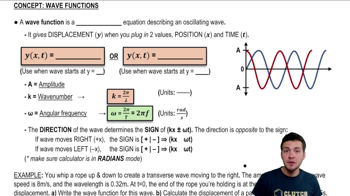
Intro to Wave Functions

Velocity

Velocity is the rate of change of position with respect to time, represented mathematically as the derivative of the position function. For the given position function, the velocity function v(t) can be found by differentiating x(t). The minimum velocity occurs when the derivative of the velocity function equals zero, indicating a change in direction or speed.
추천 영상:
가이드 코스
7:27
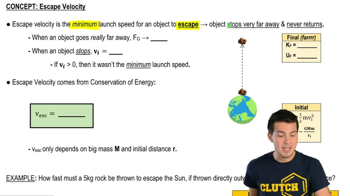
Escape Velocity

Critical Points

Critical points are values of the independent variable (in this case, time) where the derivative of a function is zero or undefined. These points are essential for finding local extrema, such as minimum or maximum values. To find the minimum velocity of the particle, one must identify the critical points of the velocity function derived from the position function.
추천 영상: