Ch 02: Kinematics in One Dimension
Knight Calc - Physics for Scientists and Engineers 5th Edition
Knight Calc5th EditionPhysics for Scientists and EngineersISBN: 9780137344796당신이 사용하는 게 아니라요?교과서 변경
2장, 문제 69b

If a Tesla Model S P100D in 'Ludicrous mode' is pushed to its limit, the first 3.0 s3.0\(\text{ s}\) of acceleration can be modeled as
ax={(35m/s3)t0 st0.40s14.6m/s2(1.5m/s3)t0.40st3.0sa_{x}=\(\begin{cases}\)(35\,\(\text{m/s}\)^3)t & 0\(\text{ s}\]\le\) t\(\le\)0.40\,\(\text{s}\)\\ 14.6\,\(\text{m/s}\)^2-(1.5\,\(\text{m/s}\)^3)t & 0.40\,\(\text{s}\[\le\) t\(\le\)3.0\,\(\text{s}\]\end{cases}\)
What acceleration would be needed to achieve the same speed in the same time at constant acceleration? Give your answer as a multiple of gg.

검증된 단계별 안내
1
Step 1: Understand the problem. The Tesla's acceleration is given as a piecewise function of time. To find the constant acceleration that achieves the same final speed in the same time, we first need to calculate the total change in velocity (Δv) over the 3.0 s using the given acceleration function.
Step 2: Break the problem into two time intervals based on the piecewise function. For the first interval (0 ≤ t ≤ 0.40 s), the acceleration is a_x = (35 m/s³)t. Use the formula for velocity change, Δv = ∫a_x dt, to integrate this acceleration over the interval.
Step 3: For the second interval (0.40 s ≤ t ≤ 3.0 s), the acceleration is a_x = 14.6 m/s² - (1.5 m/s³)t. Again, use the formula Δv = ∫a_x dt to integrate this acceleration over the interval. Add the results from both intervals to find the total change in velocity (Δv).
Step 4: Once the total change in velocity (Δv) is determined, use the kinematic equation for constant acceleration: v_f = a_c * t, where v_f is the final velocity, a_c is the constant acceleration, and t is the total time (3.0 s). Solve for a_c = Δv / t.
Step 5: To express the constant acceleration as a multiple of g (gravitational acceleration, approximately 9.8 m/s²), divide the calculated constant acceleration (a_c) by g: a_c / g. This gives the acceleration in terms of g.

비슷한 문제에 대한 검증된 영상 답변:

이 영상 해법은 위 문제에 도움이 된다고 튜터들이 추천한 것입니다.
도움이 되었나요?

주요 개념

질문에 올바르게 답하기 위해 반드시 이해해야 하는 핵심 개념들은 다음과 같습니다.

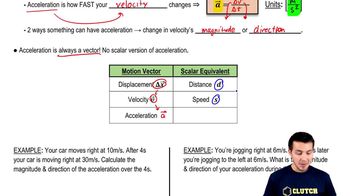
Acceleration

Acceleration is the rate of change of velocity of an object with respect to time. It is a vector quantity, meaning it has both magnitude and direction. In the context of the Tesla Model S, the acceleration can vary over time, as indicated by the piecewise function provided in the question. Understanding how to calculate and interpret acceleration is crucial for determining the forces acting on the vehicle and its performance.
추천 영상:
05:47
Intro to Acceleration

Kinematics

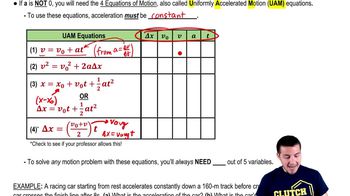
Kinematics is the branch of mechanics that deals with the motion of objects without considering the forces that cause the motion. It involves concepts such as displacement, velocity, and acceleration. In this question, kinematic equations can be used to analyze the motion of the Tesla Model S under different acceleration conditions, allowing for the calculation of speed over time. This understanding is essential for solving the problem of achieving a specific speed under constant acceleration.
추천 영상:
08:25
Kinematics Equations

Gravitational Acceleration (g)

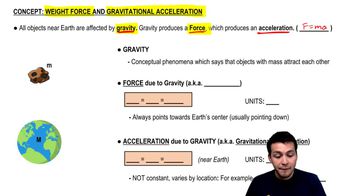
Gravitational acceleration, denoted as 'g', is the acceleration due to Earth's gravity, approximately 9.81 m/s². It serves as a reference point for measuring other accelerations. In this question, expressing the required acceleration as a multiple of 'g' allows for a clearer comparison of the Tesla's performance to a familiar standard. This concept is important for understanding how the vehicle's acceleration relates to everyday experiences of gravity.
추천 영상:
07:32
Weight Force & Gravitational Acceleration
관련 실천
교과서 질문

A rocket is launched straight up with constant acceleration. Four seconds after liftoff, a bolt falls off the side of the rocket. The bolt hits the ground 6.0 s later. What was the rocket's acceleration?

2916
views
1
rank

교과서 질문

When a 1984 Alfa Romeo Spider sports car accelerates at the maximum possible rate, its motion during the first 20 s is extremely well modeled by the simple equation vx2 = (2P/m)t, where P = 3.6 ✕ 10⁴ watts is the car's power output, m = 1200 kg is its mass, and vx is in m/s. That is, the square of the car's velocity increases linearly with time. Find an algebraic expression in terms of P, m, and t for the car's acceleration at time t.

1884
views
교과서 질문

David is driving a steady 30 m/s when he passes Tina, who is sitting in her car at rest. Tina begins to accelerate at a steady 2.0 m/s² at the instant when David passes. What is her speed as she passes him?

2024
views
교과서 질문

Nicole throws a ball straight up. Chad watches the ball from a window 5.0 m above the point where Nicole released it. The ball passes Chad on the way up, and it has a speed of 10 m/s as it passes him on the way back down. How fast did Nicole throw the ball?

2001
views
교과서 질문

A rocket in deep space has an empty mass of 150 kg and exhausts the hot gases of burned fuel at 2500m/s . It is loaded with 600 kg of fuel, which it burns in 30 s. What is the rocket's speed 10 s, 20 s, and 30 s after launch?

1621
views
교과서 질문

David is driving a steady 30 m/s when he passes Tina, who is sitting in her car at rest. Tina begins to accelerate at a steady 2.0 m/s² at the instant when David passes. How far does Tina drive before passing David?

3238
views