Ch 02: Kinematics in One Dimension
Knight Calc - Physics for Scientists and Engineers 5th Edition
Knight Calc5th EditionPhysics for Scientists and EngineersISBN: 9780137344796당신이 사용하는 게 아니라요?교과서 변경
2장, 문제 67

Nicole throws a ball straight up. Chad watches the ball from a window 5.0 m above the point where Nicole released it. The ball passes Chad on the way up, and it has a speed of 10 m/s as it passes him on the way back down. How fast did Nicole throw the ball?

검증된 단계별 안내
1
Step 1: Identify the known values and variables. Nicole throws the ball straight up, and Chad observes it from a window 5.0 m above the release point. The ball has a speed of 10 m/s as it passes Chad on the way down. We need to determine the initial velocity of the ball (Nicole's throw). The acceleration due to gravity is constant at \(-9.8\, \text{m/s}^2\).
Step 2: Use the kinematic equation \(v^2 = v_0^2 + 2a \Delta y\) to relate the velocity, initial velocity, acceleration, and displacement. Here, \(v\) is the velocity of the ball as it passes Chad on the way down (10 m/s), \(v_0\) is the initial velocity we are solving for, \(a\) is the acceleration due to gravity \(-9.8\, \text{m/s}^2\), and \(\Delta y\) is the displacement (5.0 m).
Step 3: Rearrange the kinematic equation to solve for \(v_0\): \(v_0^2 = v^2 - 2a \Delta y\). Substitute the known values: \(v = 10\, \text{m/s}\), \(a = -9.8\, \text{m/s}^2\), and \(\Delta y = 5.0\, \text{m}\).
Step 4: Take the square root of \(v_0^2\) to find \(v_0\): \(v_0 = \sqrt{v^2 - 2a \Delta y}\). Ensure the signs are correctly handled, as the acceleration is negative (gravity acts downward).
Step 5: Interpret the result. The calculated \(v_0\) represents the speed at which Nicole threw the ball upward. This value accounts for the ball's motion under the influence of gravity and its observed speed at Chad's window.

비슷한 문제에 대한 검증된 영상 답변:

이 영상 해법은 위 문제에 도움이 된다고 튜터들이 추천한 것입니다.
영상 길이:
7m
도움이 되었나요?

주요 개념

질문에 올바르게 답하기 위해 반드시 이해해야 하는 핵심 개념들은 다음과 같습니다.

Kinematics

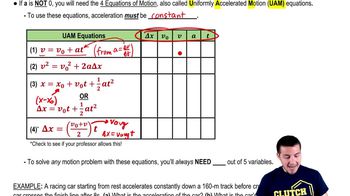
Kinematics is the branch of physics that describes the motion of objects without considering the forces that cause the motion. It involves concepts such as displacement, velocity, acceleration, and time. In this scenario, understanding the kinematic equations is essential to relate the initial velocity of the ball, its final velocity as it passes Chad, and the distance it travels.
추천 영상:
가이드 코스
08:25
Kinematics Equations

Conservation of Energy

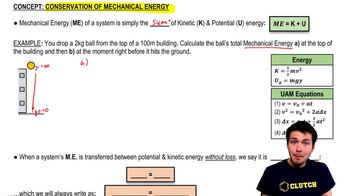
The principle of conservation of energy states that energy cannot be created or destroyed, only transformed from one form to another. In the context of the ball's motion, gravitational potential energy at its highest point is converted to kinetic energy as it falls back down. This concept helps in determining the initial speed of the ball by equating the potential energy at the peak with the kinetic energy when it passes Chad.
추천 영상:
가이드 코스
06:24
Conservation Of Mechanical Energy

Acceleration due to Gravity

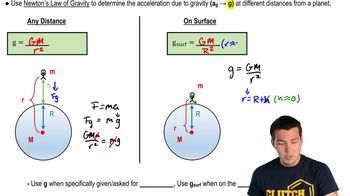
Acceleration due to gravity is the rate at which an object accelerates towards the Earth when in free fall, typically denoted as 'g' and approximately equal to 9.81 m/s². This constant affects the ball's upward and downward motion, influencing its velocity at different points. Understanding how gravity impacts the ball's trajectory is crucial for calculating the initial throw speed.
추천 영상:
가이드 코스
05:20
Acceleration Due to Gravity
관련 실천
교과서 질문

David is driving a steady 30 m/s when he passes Tina, who is sitting in her car at rest. Tina begins to accelerate at a steady 2.0 m/s² at the instant when David passes. What is her speed as she passes him?

2024
views

교과서 질문

A motorist is driving at 20 m/s when she sees that a traffic light 200 m ahead has just turned red. She knows that this light stays red for 15 s, and she wants to reach the light just as it turns green again. It takes her 1.0 s to step on the brakes and begin slowing. What is her speed as she reaches the light at the instant it turns green?

2199
views
1
rank
교과서 질문

FIGURE P2.64 shows a fixed vertical disk of radius R. A thin, frictionless rod is attached to the bottom point of the disk and to a point on the edge, making angle Φ (Greek phi) with the vertical. Find an expression for the time it takes a bead to slide from the top end of the rod to the bottom.

1592
views
교과서 질문

A very slippery block of ice slides down a smooth ramp tilted at angle θ. The ice is released from rest at vertical height h above the bottom of the ramp. Find an expression for the speed of the ice at the bottom.

1628
views
교과서 질문

David is driving a steady 30 m/s when he passes Tina, who is sitting in her car at rest. Tina begins to accelerate at a steady 2.0 m/s² at the instant when David passes. How far does Tina drive before passing David?

3238
views
교과서 질문

If a Tesla Model S P100D in 'Ludicrous mode' is pushed to its limit, the first 3.0 s3.0\(\text{ s}\) of acceleration can be modeled as

ax={(35m/s3)t0 st0.40s14.6m/s2(1.5m/s3)t0.40st3.0sa_{x}=\(\begin{cases}\)(35\,\(\text{m/s}\)^3)t & 0\(\text{ s}\]\le\) t\(\le\)0.40\,\(\text{s}\)\\ 14.6\,\(\text{m/s}\)^2-(1.5\,\(\text{m/s}\)^3)t & 0.40\,\(\text{s}\[\le\) t\(\le\)3.0\,\(\text{s}\]\end{cases}\)

What acceleration would be needed to achieve the same speed in the same time at constant acceleration? Give your answer as a multiple of gg.

326
views