
교과서 질문
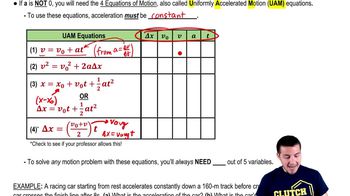
A particle moving along the x-axis has its position described by the function x = (2t3 + 2t + 1) m, where t is in s. At t = 2s, what are the particle's position?
2244
views

 검증된 단계별 안내
 08:25
08:25
 5:13
5:13 08:30
08:30A particle moving along the x-axis has its position described by the function x = (2t3 + 2t + 1) m, where t is in s. At t = 2s, what are the particle's position?
A block is suspended from a spring, pulled down, and released. The block's position-versus-time graph is shown in FIGURE P2.38. At what times is the velocity zero? At what times is the velocity most positive? Most negative?
The position of a particle is given by the function x = (2t3 = 6t2 + 12) m, where t is in s. At what time does the particle reach its minimum velocity? What is (vx)min?
FIGURE EX2.32 shows the acceleration graph for a particle that starts from rest at t = 0 s. What is the particle's velocity at t = 6 s?
A particle moving along the x-axis has its veocity described by the function vx = 2t2 m/s, where t is in s. itsinitial position is x0 = 1 m at t0 = 0 s. At t = 1 s, what are the particle's position?
The position of a particle is given by the function x = (2t3 - 6t2 + 12) m, where t is in s. At what time is the acceleration zero?