Ch 03: Vectors and Coordinate Systems
Knight Calc - Physics for Scientists and Engineers 5th Edition
Knight Calc5th EditionPhysics for Scientists and EngineersISBN: 9780137344796당신이 사용하는 게 아니라요?교과서 변경
3장, 문제 4

A velocity vector 40 degrees below the positive x-axis has a y-component of -10 m/s. What is the value of its x-component?

검증된 단계별 안내
1
Start by understanding the relationship between the components of a vector and its magnitude and direction. The x-component and y-component of a vector can be expressed using trigonometric functions: \( v_x = v \cos(\theta) \) and \( v_y = v \sin(\theta) \), where \( v \) is the magnitude of the vector and \( \theta \) is the angle it makes with the positive x-axis.
From the problem, the angle \( \theta \) is given as 40 degrees below the positive x-axis. This means \( \theta = -40^{\circ} \) (negative because it is below the x-axis). The y-component \( v_y \) is given as \( -10 \, \text{m/s} \).
Use the equation for the y-component: \( v_y = v \sin(\theta) \). Substitute \( v_y = -10 \, \text{m/s} \) and \( \theta = -40^{\circ} \) into the equation to solve for the magnitude of the velocity \( v \): \( v = \frac{v_y}{\sin(\theta)} \).
Once you have the magnitude \( v \), use the equation for the x-component: \( v_x = v \cos(\theta) \). Substitute the value of \( v \) and \( \theta = -40^{\circ} \) into this equation to calculate \( v_x \).
Simplify the expression for \( v_x \) to find the x-component of the velocity vector. Ensure that the units remain consistent throughout the calculation (meters per second).

비슷한 문제에 대한 검증된 영상 답변:

이 영상 해법은 위 문제에 도움이 된다고 튜터들이 추천한 것입니다.
영상 길이:
1m
도움이 되었나요?

주요 개념

질문에 올바르게 답하기 위해 반드시 이해해야 하는 핵심 개념들은 다음과 같습니다.

Velocity Vector

A velocity vector represents the speed and direction of an object's motion. It is typically expressed in terms of its components along the coordinate axes, such as x and y. The direction of the vector is crucial for determining its components, which can be calculated using trigonometric functions based on the angle of the vector relative to the axes.
추천 영상:
가이드 코스
06:44
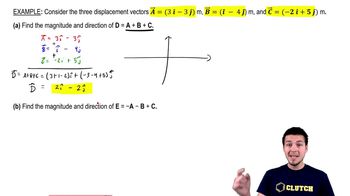
Adding 3 Vectors in Unit Vector Notation

Trigonometric Functions

Trigonometric functions, such as sine and cosine, relate the angles of a triangle to the ratios of its sides. In the context of velocity vectors, these functions are used to resolve a vector into its components. For a vector at an angle θ, the x-component can be found using the cosine function, while the y-component is found using the sine function.
추천 영상:
가이드 코스
08:30
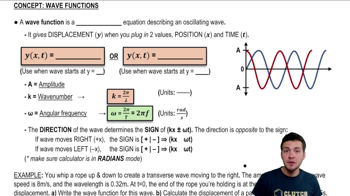
Intro to Wave Functions

Component Resolution

Component resolution is the process of breaking down a vector into its perpendicular components, typically along the x and y axes. This is essential for analyzing motion in two dimensions. By knowing one component and the angle, the other component can be calculated, allowing for a complete understanding of the vector's behavior in a given context.
추천 영상:
가이드 코스
07:30
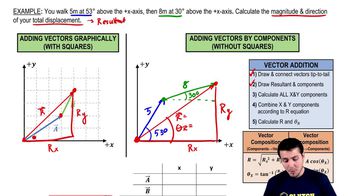
Vector Addition By Components