Ch 03: Vectors and Coordinate Systems
Knight Calc - Physics for Scientists and Engineers 5th Edition
Knight Calc5th EditionPhysics for Scientists and EngineersISBN: 9780137344796당신이 사용하는 게 아니라요?교과서 변경
3장, 문제 3a

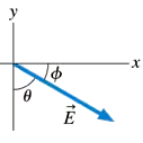
What are the x- and y-components of vector E shown in FIGURE EX3.3 in terms of the angle θ and the magnitude E?

검증된 단계별 안내
1
Step 1: Identify the components of the vector. The vector shown in the figure has a magnitude E and is oriented at an angle θ with respect to the positive x-axis. The x-component and y-component of the vector can be determined using trigonometric functions.
Step 2: Use the cosine function to find the x-component. The x-component of the vector is given by the formula: Ecosθ. This is because the cosine function relates the adjacent side (x-component) to the hypotenuse (magnitude of the vector).
Step 3: Use the sine function to find the y-component. The y-component of the vector is given by the formula: Esinθ. This is because the sine function relates the opposite side (y-component) to the hypotenuse (magnitude of the vector).
Step 4: Write the vector components in terms of E and θ. The x-component is Ecosθ, and the y-component is Esinθ. These components represent the projection of the vector along the x-axis and y-axis respectively.
Step 5: Verify the components using the Pythagorean theorem. The magnitude of the vector E should satisfy the equation: E2, which is consistent with the sum of the squares of the x-component and y-component.

비슷한 문제에 대한 검증된 영상 답변:

이 영상 해법은 위 문제에 도움이 된다고 튜터들이 추천한 것입니다.
영상 길이:
2m

주요 개념

질문에 올바르게 답하기 위해 반드시 이해해야 하는 핵심 개념들은 다음과 같습니다.

Vector Components

Vectors can be broken down into components along the axes of a coordinate system. For a vector A at an angle θ, the x-component (Ax) is found using the cosine function, while the y-component (Ay) is determined using the sine function. This decomposition allows for easier analysis of vector behavior in two-dimensional space.
추천 영상:
가이드 코스
07:30
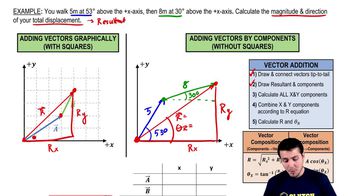
Vector Addition By Components

Trigonometric Functions

Trigonometric functions, specifically sine and cosine, relate the angles of a triangle to the ratios of its sides. In the context of vector components, cosine(θ) gives the ratio of the adjacent side (x-component) to the hypotenuse (magnitude of the vector), while sine(θ) gives the ratio of the opposite side (y-component) to the hypotenuse. These functions are essential for calculating the components of vectors.
추천 영상:
가이드 코스
08:30
Intro to Wave Functions

Magnitude of a Vector

The magnitude of a vector is its length and represents the overall strength or size of the vector. It is denoted as E in this context. The magnitude is crucial for determining the components of the vector, as the x- and y-components are derived from the magnitude multiplied by the respective trigonometric functions of the angle θ.
추천 영상:
가이드 코스
03:59
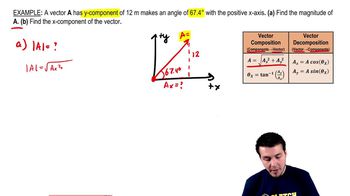
Calculating Magnitude & Components of a Vector