Ch 03: Vectors and Coordinate Systems
Knight Calc - Physics for Scientists and Engineers 5th Edition
Knight Calc5th EditionPhysics for Scientists and EngineersISBN: 9780137344796당신이 사용하는 게 아니라요?교과서 변경
3장, 문제 13b

Let A = 2i + 3j, B = 2i - 4j, and C = A + B. Draw a coordinate system and on it show vectors A, B, and C.

검증된 단계별 안내
1
Step 1: Understand the problem. You are given two vectors A and B in component form, and you need to find their sum (vector C). Additionally, you are asked to represent these vectors graphically on a coordinate system.
Step 2: Add the components of vectors A and B to find vector C. Use the formula for vector addition: \( C = A + B \). For the x-components, add \( 2 + 2 \), and for the y-components, add \( 3 - 4 \). This will give the components of vector C.
Step 3: Write the resulting vector C in component form. After performing the addition, vector C will be expressed as \( C = (x_{C})i + (y_{C})j \), where \( x_{C} \) and \( y_{C} \) are the calculated x and y components.
Step 4: Draw a coordinate system. Label the axes as x and y. Plot vector A starting from the origin, with its x-component (2) and y-component (3). Then plot vector B starting from the origin, with its x-component (2) and y-component (-4). Finally, plot vector C starting from the origin, using the components calculated in Step 3.
Step 5: Use arrows to represent the vectors on the graph. Ensure that the direction and magnitude of each vector are accurately represented. Label each vector (A, B, and C) clearly on the graph to complete the visualization.

비슷한 문제에 대한 검증된 영상 답변:

이 영상 해법은 위 문제에 도움이 된다고 튜터들이 추천한 것입니다.
영상 길이:
3m
도움이 되었나요?

주요 개념

질문에 올바르게 답하기 위해 반드시 이해해야 하는 핵심 개념들은 다음과 같습니다.

Vector Addition

Vector addition involves combining two or more vectors to form a resultant vector. This is done by adding their corresponding components. For example, if vector A has components (2, 3) and vector B has components (2, -4), their sum, vector C, is obtained by adding the i-components and the j-components separately, resulting in C = (2+2)i + (3-4)j = 4i - 1j.
추천 영상:
가이드 코스
07:30
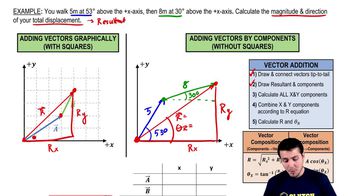
Vector Addition By Components

Coordinate System

A coordinate system is a two-dimensional plane defined by two perpendicular axes, typically labeled as the x-axis (horizontal) and y-axis (vertical). Each point in this system can be represented by an ordered pair (x, y), where x indicates the position along the x-axis and y indicates the position along the y-axis. This system is essential for graphically representing vectors and their components.
추천 영상:
가이드 코스
05:17
Coordinates of Center of Mass of 4 objects

Vector Representation

Vectors can be represented graphically as arrows in a coordinate system, where the length of the arrow indicates the magnitude and the direction of the arrow indicates the vector's direction. For instance, vector A = 2i + 3j would be represented as an arrow starting from the origin (0,0) and pointing to the point (2,3) in the coordinate system. This visual representation helps in understanding the relationship between different vectors.
추천 영상:
가이드 코스
06:44
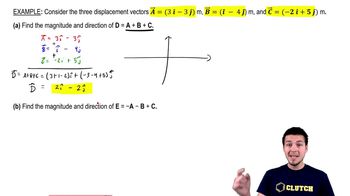
Adding 3 Vectors in Unit Vector Notation