Ch 03: Vectors and Coordinate Systems
Knight Calc - Physics for Scientists and Engineers 5th Edition
Knight Calc5th EditionPhysics for Scientists and EngineersISBN: 9780137344796당신이 사용하는 게 아니라요?교과서 변경
3장, 문제 12c

Let A = 4i - 2j, B = -3i + 5j, and C = A + B. What are the magnitude and direction of vector C?

검증된 단계별 안내
1
Step 1: Add the components of vectors A and B to find vector C. The x-component of C is the sum of the x-components of A and B: \( C_x = A_x + B_x \). Similarly, the y-component of C is the sum of the y-components of A and B: \( C_y = A_y + B_y \).
Step 2: Substitute the given components of A and B into the equations. For A = 4i - 2j, \( A_x = 4 \) and \( A_y = -2 \). For B = -3i + 5j, \( B_x = -3 \) and \( B_y = 5 \). Calculate \( C_x \) and \( C_y \).
Step 3: Use the Pythagorean theorem to calculate the magnitude of vector C. The formula is \( |C| = \sqrt{C_x^2 + C_y^2} \). Substitute the values of \( C_x \) and \( C_y \) into this formula.
Step 4: Determine the direction (angle) of vector C using the formula \( \theta = \arctan\left(\frac{C_y}{C_x}\right) \). Ensure you consider the signs of \( C_x \) and \( C_y \) to determine the correct quadrant for the angle.
Step 5: Express the final answers for the magnitude and direction of vector C. The magnitude is a scalar value, and the direction is typically expressed in degrees or radians, measured counterclockwise from the positive x-axis.

비슷한 문제에 대한 검증된 영상 답변:

이 영상 해법은 위 문제에 도움이 된다고 튜터들이 추천한 것입니다.
영상 길이:
3m
도움이 되었나요?

주요 개념

질문에 올바르게 답하기 위해 반드시 이해해야 하는 핵심 개념들은 다음과 같습니다.

Vector Addition

Vector addition involves combining two or more vectors to form a resultant vector. This is done by adding their corresponding components. For example, if vector A has components (4, -2) and vector B has components (-3, 5), the resultant vector C is obtained by adding these components: C = (4 + (-3), -2 + 5) = (1, 3).
추천 영상:
가이드 코스
07:30
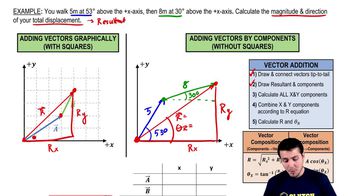
Vector Addition By Components

Magnitude of a Vector

The magnitude of a vector is a measure of its length and is calculated using the Pythagorean theorem. For a vector C with components (x, y), the magnitude is given by |C| = √(x² + y²). This value represents how far the vector extends in space, regardless of its direction.
추천 영상:
가이드 코스
03:59
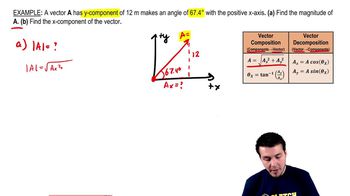
Calculating Magnitude & Components of a Vector

Direction of a Vector

The direction of a vector indicates the orientation of the vector in space and is often expressed as an angle relative to a reference axis. For a vector C with components (x, y), the direction can be found using the tangent function: θ = arctan(y/x). This angle helps in understanding how the vector is positioned in relation to the coordinate axes.
추천 영상:
가이드 코스
06:44
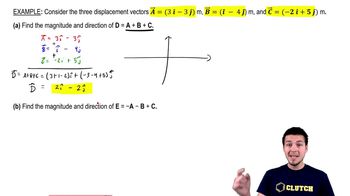
Adding 3 Vectors in Unit Vector Notation