Ch 03: Vectors and Coordinate Systems
Knight Calc - Physics for Scientists and Engineers 5th Edition
Knight Calc5th EditionPhysics for Scientists and EngineersISBN: 9780137344796당신이 사용하는 게 아니라요?교과서 변경
3장, 문제 23a

The position of a particle as a function of time is given by r\(\overrightarrow{r}\) = ( 5.0î +4.0ĵ )t² m where t is in seconds. What is the particle's distance from the origin at t = 0, 2, and 5 s?

검증된 단계별 안내
1
Step 1: Understand the given position vector function 𝓇 = (5.0î + 4.0ĵ)t² m, where î and ĵ are unit vectors in the x and y directions respectively, and t is the time in seconds. This function describes the particle's position in two dimensions as a function of time.
Step 2: To find the distance of the particle from the origin at any time t, use the formula for the magnitude of a vector: |𝓇| = √((x-component)² + (y-component)²). Here, the x-component is 5.0t² and the y-component is 4.0t².
Step 3: Substitute the values of t (0, 2, and 5 seconds) into the position vector components to calculate the x and y components of the position at each time. For example, at t = 2 s, the x-component is 5.0(2)² and the y-component is 4.0(2)².
Step 4: Use the magnitude formula |𝓇| = √((5.0t²)² + (4.0t²)²) to calculate the distance from the origin at each time. For instance, at t = 2 s, substitute the x and y components into the formula: |𝓇| = √((5.0(2)²)² + (4.0(2)²)²).
Step 5: Repeat the calculation for t = 0 s, t = 2 s, and t = 5 s to find the distances at each time. Note that at t = 0 s, the position vector components are both zero, so the distance from the origin is also zero.

비슷한 문제에 대한 검증된 영상 답변:

이 영상 해법은 위 문제에 도움이 된다고 튜터들이 추천한 것입니다.
영상 길이:
2m
도움이 되었나요?

주요 개념

질문에 올바르게 답하기 위해 반드시 이해해야 하는 핵심 개념들은 다음과 같습니다.

Position Vector

The position vector describes the location of a particle in space relative to a reference point, typically the origin. In this case, the position vector is given by 𝓇 = (5.0î + 4.0ĵ)t² m, indicating that the particle's position changes with time according to the quadratic function of time, t. The components of the vector represent the particle's displacement in the x (î) and y (ĵ) directions.
추천 영상:
가이드 코스
07:07
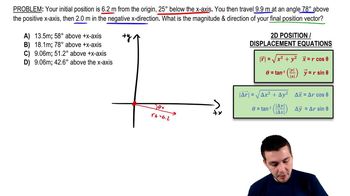
Final Position Vector

Distance from the Origin

The distance from the origin to a point in space can be calculated using the Euclidean distance formula. For a position vector 𝓇 = (x, y), the distance d from the origin is given by d = √(x² + y²). In this problem, we need to evaluate the position vector at specific times and then apply this formula to find the distance at t = 0, 2, and 5 seconds.
추천 영상:
가이드 코스
04:39
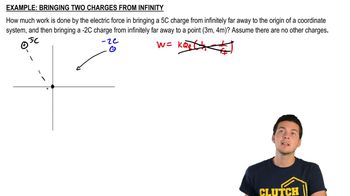
Work to Bring Two Charges From Infinity

Time Dependence

In this context, the position of the particle is explicitly dependent on time, as indicated by the t² term in the position vector equation. This means that as time progresses, the particle's position changes, and thus its distance from the origin will also vary. Understanding how the position evolves over time is crucial for calculating the distance at different time intervals.
추천 영상:
가이드 코스
05:59
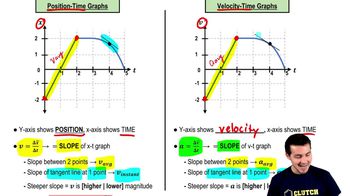
Velocity-Time Graphs & Acceleration