Ch 03: Vectors and Coordinate Systems
Knight Calc - Physics for Scientists and Engineers 5th Edition
Knight Calc5th EditionPhysics for Scientists and EngineersISBN: 9780137344796당신이 사용하는 게 아니라요?교과서 변경
3장, 문제 23b

The position of a particle as a function of time is given by r\(\overrightarrow{r}\) = ( 5.0î +4.0ĵ )t² m where t is in seconds. Find an expression for the particle's velocity v\(\overrightarrow{v}\) as a function of time.

검증된 단계별 안내
1
Step 1: Recall that velocity is the time derivative of position. To find the velocity vector \( \mathbf{v}(t) \), differentiate the position vector \( \mathbf{r}(t) \) with respect to time \( t \). The position vector is given as \( \mathbf{r}(t) = (5.0 \mathbf{i} + 4.0 \mathbf{j}) t^2 \).
Step 2: Apply the derivative to each component of \( \mathbf{r}(t) \). For the \( \mathbf{i} \)-component, differentiate \( 5.0 t^2 \) with respect to \( t \). For the \( \mathbf{j} \)-component, differentiate \( 4.0 t^2 \) with respect to \( t \).
Step 3: Use the power rule for differentiation, which states \( \frac{d}{dt}(t^n) = n t^{n-1} \). For the \( \mathbf{i} \)-component, \( \frac{d}{dt}(5.0 t^2) = 2 \cdot 5.0 \cdot t = 10.0 t \). For the \( \mathbf{j} \)-component, \( \frac{d}{dt}(4.0 t^2) = 2 \cdot 4.0 \cdot t = 8.0 t \).
Step 4: Combine the differentiated components to form the velocity vector. The velocity vector is \( \mathbf{v}(t) = (10.0 t \mathbf{i} + 8.0 t \mathbf{j}) \).
Step 5: Write the final expression for the velocity vector as \( \mathbf{v}(t) = t (10.0 \mathbf{i} + 8.0 \mathbf{j}) \), which shows the velocity as a function of time.

비슷한 문제에 대한 검증된 영상 답변:

이 영상 해법은 위 문제에 도움이 된다고 튜터들이 추천한 것입니다.
영상 길이:
2m
도움이 되었나요?

주요 개념

질문에 올바르게 답하기 위해 반드시 이해해야 하는 핵심 개념들은 다음과 같습니다.

Position Vector

The position vector describes the location of a particle in space as a function of time. In this case, the position vector 𝓇 = (5.0î + 4.0ĵ)t² m indicates that the particle's position changes quadratically with time, with components in the x and y directions represented by the coefficients of î and ĵ, respectively.
추천 영상:
가이드 코스
07:07
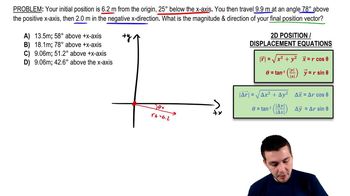
Final Position Vector

Velocity

Velocity is the rate of change of the position vector with respect to time. It is a vector quantity that indicates both the speed and direction of a particle's motion. To find the velocity as a function of time, one must differentiate the position vector with respect to time, yielding a new vector that represents how the position changes over time.
추천 영상:
가이드 코스
7:27
Escape Velocity

Differentiation

Differentiation is a fundamental concept in calculus that involves finding the derivative of a function. In physics, it is used to determine rates of change, such as velocity from position. By applying differentiation to the position vector with respect to time, we can derive the expression for velocity, which provides insight into the particle's motion at any given moment.
추천 영상:
가이드 코스
13:04
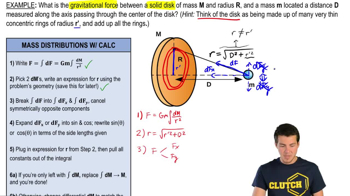
Gravitational Force from a Solid Disk