
Ch 04: Kinematics in Two Dimensions
Knight Calc - Physics for Scientists and Engineers 5th Edition
Knight Calc5th EditionPhysics for Scientists and EngineersISBN: 9780137344796당신이 사용하는 게 아니라요?교과서 변경
4장, 문제 50b

A ball is thrown toward a cliff of height h with a speed of 30 m/s and an angle of 60° above horizontal. It lands on the edge of the cliff 4.0 s later. What was the maximum height of the ball?

검증된 단계별 안내
1
Step 1: Break the initial velocity into its horizontal and vertical components using trigonometric functions. The vertical component of velocity is given by \( v_{y0} = v_0 \sin \theta \), and the horizontal component is \( v_{x0} = v_0 \cos \theta \). Here, \( v_0 = 30 \, \text{m/s} \) and \( \theta = 60^\circ \).
Step 2: Use the kinematic equation for vertical motion to find the time at which the ball reaches its maximum height. At maximum height, the vertical velocity becomes zero, so \( v_y = v_{y0} - g t \), where \( g \) is the acceleration due to gravity (\( 9.8 \, \text{m/s}^2 \)). Solve for \( t \) when \( v_y = 0 \).
Step 3: Calculate the maximum height using the kinematic equation \( y = v_{y0} t - \frac{1}{2} g t^2 \). Substitute the time \( t \) found in Step 2 and the vertical velocity \( v_{y0} \) into this equation.
Step 4: Add the initial height of the ball (if any) to the calculated height from Step 3. In this case, the ball starts from ground level, so the initial height is zero.
Step 5: Verify the result conceptually by ensuring the calculated maximum height is consistent with the given time of flight and the motion of the ball. The total time of flight (4.0 s) should include the time to reach maximum height and the time to descend from it.

비슷한 문제에 대한 검증된 영상 답변:

이 영상 해법은 위 문제에 도움이 된다고 튜터들이 추천한 것입니다.
영상 길이:
6m

주요 개념

질문에 올바르게 답하기 위해 반드시 이해해야 하는 핵심 개념들은 다음과 같습니다.

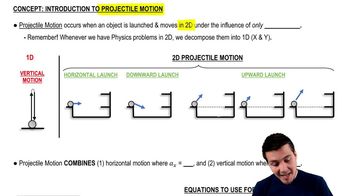
Projectile Motion

Projectile motion refers to the motion of an object that is thrown into the air and is subject to the force of gravity. It can be analyzed in two dimensions: horizontal and vertical. The horizontal motion is uniform, while the vertical motion is influenced by gravitational acceleration. Understanding the components of initial velocity and the effects of gravity is essential for solving problems related to projectiles.
추천 영상:
가이드 코스
04:44
Introduction to Projectile Motion

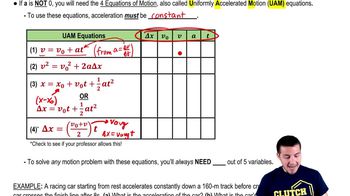
Kinematic Equations

Kinematic equations describe the motion of objects under constant acceleration. For projectile motion, these equations can be used to relate displacement, initial velocity, final velocity, acceleration, and time. In this context, they help calculate the maximum height reached by the ball by analyzing its vertical motion separately from its horizontal motion.
추천 영상:
가이드 코스
08:25
Kinematics Equations

Trigonometric Functions

Trigonometric functions, such as sine and cosine, are crucial for resolving the initial velocity of the projectile into its horizontal and vertical components. For an angle of 60°, the vertical component can be found using the sine function, while the horizontal component uses the cosine function. These components are essential for applying kinematic equations to determine the ball's trajectory and maximum height.
추천 영상:
가이드 코스
08:30
Intro to Wave Functions
관련 실천
교과서 질문

You are watching an archery tournament when you start wondering how fast an arrow is shot from the bow. Remembering your physics, you ask one of the archers to shoot an arrow parallel to the ground. You find the arrow stuck in the ground 60 m away, making a 30° angle with the ground. How fast was the arrow shot?

2499
views
교과서 질문

A projectile is launched from ground level at angle θ and speed v0 into a headwind that causes a constant horizontal acceleration of magnitude a opposite the direction of motion. Find an expression in terms of a and g for the launch angle that gives maximum range.

2230
views
교과서 질문

You're 6.0 m from one wall of the house seen in FIGURE P4.55. You want to toss a ball to your friend who is 6.0 m from the opposite wall. The throw and catch each occur 1.0 m above the ground. At what angle should you toss the ball?

2096
views
교과서 질문

A gray kangaroo can bound across level ground with each jump carrying it 10 m from the takeoff point. Typically the kangaroo leaves the ground at a 20° angle. If this is so: What is its maximum height above the ground?

451
views
교과서 질문

A ball is thrown toward a cliff of height h with a speed of 30 m/s and an angle of 60° above horizontal. It lands on the edge of the cliff 4.0 s later. What is the ball's impact speed?

2052
views
교과서 질문

A projectile is launched from ground level at angle θ and speed v₀ into a headwind that causes a constant horizontal acceleration of magnitude a opposite the direction of motion. What is the angle for maximum range if a is 10% of g?

2490
views
1
rank