
Ch 04: Kinematics in Two Dimensions
Knight Calc - Physics for Scientists and Engineers 5th Edition
Knight Calc5th EditionPhysics for Scientists and EngineersISBN: 9780137344796당신이 사용하는 게 아니라요?교과서 변경
4장, 문제 50c

A ball is thrown toward a cliff of height h with a speed of 30 m/s and an angle of 60° above horizontal. It lands on the edge of the cliff 4.0 s later. What is the ball's impact speed?

검증된 단계별 안내
1
Step 1: Break the initial velocity into horizontal and vertical components. Use the equations: \( v_{x0} = v_0 \cos(\theta) \) and \( v_{y0} = v_0 \sin(\theta) \), where \( v_0 = 30 \, \text{m/s} \) and \( \theta = 60^\circ \).
Step 2: Calculate the vertical velocity at the time of impact using the kinematic equation: \( v_y = v_{y0} - g t \), where \( g = 9.8 \, \text{m/s}^2 \) and \( t = 4.0 \, \text{s} \).
Step 3: The horizontal velocity remains constant throughout the motion because there is no horizontal acceleration. Thus, \( v_x = v_{x0} \).
Step 4: Use the Pythagorean theorem to find the magnitude of the impact speed. The total speed is given by \( v = \sqrt{v_x^2 + v_y^2} \).
Step 5: Combine the results from Steps 2 and 3 into the equation from Step 4 to determine the ball's impact speed.

비슷한 문제에 대한 검증된 영상 답변:

이 영상 해법은 위 문제에 도움이 된다고 튜터들이 추천한 것입니다.
영상 길이:
9m

주요 개념

질문에 올바르게 답하기 위해 반드시 이해해야 하는 핵심 개념들은 다음과 같습니다.

Projectile Motion

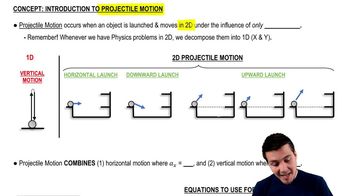
Projectile motion refers to the motion of an object that is launched into the air and is subject to gravitational forces. It can be analyzed by breaking it into horizontal and vertical components. The horizontal motion is uniform, while the vertical motion is influenced by gravity, leading to a parabolic trajectory. Understanding these components is essential for calculating the object's position and speed at any point in time.
추천 영상:
가이드 코스
04:44
Introduction to Projectile Motion

Kinematic Equations

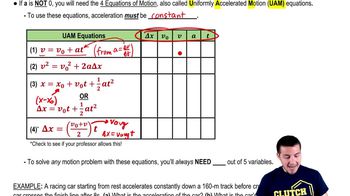
Kinematic equations describe the relationships between an object's displacement, velocity, acceleration, and time. For projectile motion, these equations can be applied separately to the horizontal and vertical components. They allow us to calculate final velocities and positions based on initial conditions and the effects of gravity, which is crucial for determining the impact speed of the ball in this scenario.
추천 영상:
가이드 코스
08:25
Kinematics Equations

Vector Addition

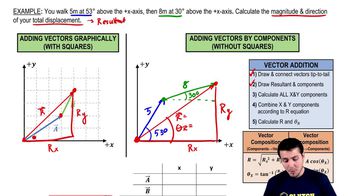
Vector addition is the process of combining two or more vectors to determine a resultant vector. In the context of projectile motion, the velocity of the ball just before impact can be found by adding its horizontal and vertical velocity components. Since these components are perpendicular to each other, the Pythagorean theorem is used to find the magnitude of the resultant velocity, which represents the ball's impact speed.
추천 영상:
가이드 코스
07:30
Vector Addition By Components