Ch 04: Kinematics in Two Dimensions
Knight Calc - Physics for Scientists and Engineers 5th Edition
Knight Calc5th EditionPhysics for Scientists and EngineersISBN: 9780137344796당신이 사용하는 게 아니라요?교과서 변경
4장, 문제 21b

A kayaker needs to paddle north across a 100-m-wide harbor. The tide is going out, creating a tidal current that flows to the east at 2.0 m/s. The kayaker can paddle with a speed of 3.0 m/s. How long will it take him to cross?

검증된 단계별 안내
1
Step 1: Recognize that the kayaker's motion is influenced by two components: the northward paddling velocity and the eastward tidal current. The kayaker's paddling speed is 3.0 m/s, and the tidal current flows east at 2.0 m/s. To determine the time to cross, focus only on the northward motion since the width of the harbor is given as 100 m.
Step 2: The kayaker's northward velocity is the component of his paddling speed directed perpendicular to the tidal current. Since the kayaker must paddle at an angle to counteract the eastward current, the northward velocity can be calculated using trigonometry. The northward velocity is given by \( v_{north} = v_{kayaker} \cdot \cos(\theta) \), where \( \theta \) is the angle the kayaker paddles relative to the north direction.
Step 3: To counteract the eastward current, the kayaker must paddle at an angle such that the eastward component of his paddling velocity cancels the tidal current. This condition is expressed as \( v_{kayaker} \cdot \sin(\theta) = v_{current} \). Solve for \( \sin(\theta) \) using \( \sin(\theta) = \frac{v_{current}}{v_{kayaker}} \). Substitute \( v_{current} = 2.0 \, \text{m/s} \) and \( v_{kayaker} = 3.0 \, \text{m/s} \) to find \( \sin(\theta) \).
Step 4: Use the Pythagorean identity \( \sin^2(\theta) + \cos^2(\theta) = 1 \) to calculate \( \cos(\theta) \). Substitute \( \sin(\theta) \) from Step 3 into the identity to find \( \cos(\theta) \). Then, calculate the northward velocity \( v_{north} \) using \( v_{north} = v_{kayaker} \cdot \cos(\theta) \).
Step 5: Once \( v_{north} \) is determined, calculate the time to cross the harbor using the formula \( t = \frac{d}{v_{north}} \), where \( d = 100 \, \text{m} \) is the width of the harbor. Substitute \( v_{north} \) into the equation to find the time required for the kayaker to cross.

비슷한 문제에 대한 검증된 영상 답변:

이 영상 해법은 위 문제에 도움이 된다고 튜터들이 추천한 것입니다.
영상 길이:
11m
도움이 되었나요?

주요 개념

질문에 올바르게 답하기 위해 반드시 이해해야 하는 핵심 개념들은 다음과 같습니다.

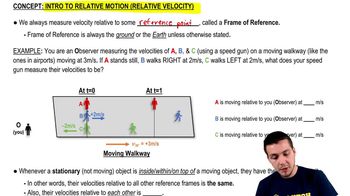
Relative Velocity

Relative velocity is the velocity of an object as observed from a particular reference frame. In this scenario, the kayaker's velocity must be analyzed in relation to the tidal current. The effective velocity of the kayaker across the harbor will be the vector sum of his paddling speed and the current's speed, which affects his overall path.
추천 영상:
가이드 코스
04:27
Intro to Relative Motion (Relative Velocity)

Vector Addition

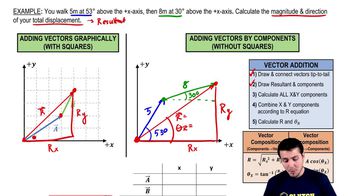
Vector addition is the process of combining two or more vectors to determine a resultant vector. In this case, the kayaker's velocity vector (3.0 m/s north) and the current's velocity vector (2.0 m/s east) must be added to find the resultant velocity. This involves using the Pythagorean theorem to calculate the magnitude and direction of the resultant vector.
추천 영상:
가이드 코스
07:30
Vector Addition By Components

Time Calculation

Time calculation in physics often involves using the formula time = distance / speed. Once the effective speed of the kayaker across the harbor is determined, this formula can be applied to find the time it takes to cross the 100-meter width. Understanding how to manipulate this formula is essential for solving problems involving motion.
추천 영상:
가이드 코스
04:43
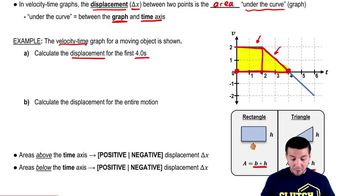
Calculating Displacement from Velocity-Time Graphs