Ch 04: Kinematics in Two Dimensions
Knight Calc - Physics for Scientists and Engineers 5th Edition
Knight Calc5th EditionPhysics for Scientists and EngineersISBN: 9780137344796당신이 사용하는 게 아니라요?교과서 변경
4장, 문제 13b

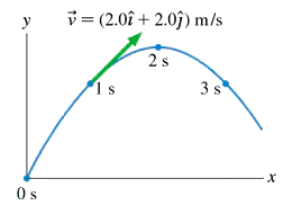
A physics student on Planet Exidor throws a ball, and it follows the parabolic trajectory shown in FIGURE EX4.13. The ball's position is shown at 1 s intervals until t = 3s. At t = 1s, the ball's velocity is v = (2.0 i + 2.0 j) m/s. What is the value of g on Planet Exidor?

검증된 단계별 안내
1
Identify the known values: At t = 1 s, the velocity of the ball is \( \mathbf{v} = 2.0 \mathbf{i} + 2.0 \mathbf{j} \) m/s. The ball's motion is parabolic, indicating that it is under the influence of a constant gravitational acceleration \( \mathbf{g} \). The horizontal component of velocity remains constant, while the vertical component changes due to gravity.
Understand the relationship between acceleration and the change in velocity: The vertical acceleration \( g \) is responsible for the change in the vertical component of velocity \( v_y \). The equation for vertical velocity is \( v_y = v_{y0} - g t \), where \( v_{y0} \) is the initial vertical velocity and \( t \) is the time.
Determine the vertical velocity at a later time: From the problem, the ball's position is shown at 1-second intervals. At \( t = 2 \) s, the vertical velocity \( v_y \) can be calculated using the change in position or inferred from the trajectory data provided in the figure (not shown here).
Use the change in vertical velocity to calculate \( g \): The change in vertical velocity \( \Delta v_y \) over a time interval \( \Delta t \) is related to \( g \) by the equation \( g = \frac{\Delta v_y}{\Delta t} \). Substitute the known values of \( \Delta v_y \) and \( \Delta t \) (e.g., \( \Delta t = 1 \) s) to find \( g \).
Conclude the calculation: Once \( g \) is determined, it represents the gravitational acceleration on Planet Exidor. Ensure that the units are consistent (e.g., m/s²) and verify the result using the trajectory data provided in the figure.

비슷한 문제에 대한 검증된 영상 답변:

이 영상 해법은 위 문제에 도움이 된다고 튜터들이 추천한 것입니다.
영상 길이:
4m
도움이 되었나요?

주요 개념

질문에 올바르게 답하기 위해 반드시 이해해야 하는 핵심 개념들은 다음과 같습니다.

Projectile Motion

Projectile motion refers to the motion of an object that is thrown or projected into the air, subject to the force of gravity. It follows a curved path known as a parabola, characterized by horizontal and vertical components of motion. Understanding this concept is crucial for analyzing the trajectory of the ball on Planet Exidor, as it helps in determining how the initial velocity and gravitational acceleration affect the ball's path.
추천 영상:
가이드 코스
04:44
Introduction to Projectile Motion

Velocity and Acceleration

Velocity is a vector quantity that describes the rate of change of an object's position, including both speed and direction. Acceleration, particularly gravitational acceleration (g), is the rate of change of velocity over time. In this scenario, knowing the initial velocity of the ball allows us to calculate the gravitational acceleration on Planet Exidor by analyzing how the velocity changes as the ball moves along its trajectory.
추천 영상:
가이드 코스
11:21
Rotational Velocity & Acceleration

Gravitational Acceleration

Gravitational acceleration (g) is the acceleration experienced by an object due to the force of gravity acting on it. On Earth, this value is approximately 9.81 m/s², but it can vary on different planets. To find the value of g on Planet Exidor, one can use the kinematic equations of motion, which relate the initial velocity, time, and displacement of the ball to determine how gravity influences its trajectory.
추천 영상:
가이드 코스
07:32
Weight Force & Gravitational Acceleration
관련 실천
교과서 질문

You have a remote-controlled car that has been programmed to have velocity v=(3ti+2t2j)m/s\(\mathbf{v}\) = (-3t\(\mathbf{i}\) + 2t^2\(\mathbf{j}\)) \, \(\text{m/s}\), where t is in s. At t = 0 s, the car is at r0=(3.0i+2.0j)m\(\mathbf{r}\)_0 = (3.0\(\mathbf{i}\) + 2.0\(\mathbf{j}\)) \, \(\text{m}\). What are the car's position vector?

1941
views

교과서 질문

A kayaker needs to paddle north across a 100-m-wide harbor. The tide is going out, creating a tidal current that flows to the east at 2.0 m/s. The kayaker can paddle with a speed of 3.0 m/s. How long will it take him to cross?

3360
views
교과서 질문

A rifle is aimed horizontally at a target 50 m away. The bullet hits the target 2.0 cm below the aim point. (b) What was the bullet's speed as it left the barrel?

2516
views
교과서 질문

A supply plane needs to drop a package of food to scientists working on a glacier in Greenland. The plane flies 100 m above the glacier at a speed of 150 m/s. How far short of the target should it drop the package?

2055
views
교과서 질문

A physics student on Planet Exidor throws a ball, and it follows the parabolic trajectory shown in FIGURE EX4.13. The ball's position is shown at 1 s intervals until t = 3s. At t = 1s, the ball's velocity is v = (2.0 i + 2.0 j) m/s. Determine the ball's velocity at t = 0 s, 2s, and 3s.

2732
views
1
rank
교과서 질문

On the Apollo 14 mission to the moon, astronaut Alan Shepard hit a golf ball with a 6 iron. The free-fall acceleration on the moon is 1/6 of its value on earth. Suppose he hit the ball with a speed of 25 m/s at an angle 30 degrees above the horizontal. For how much more time was the ball in flight?

2247
views