Ch 04: Kinematics in Two Dimensions
Knight Calc - Physics for Scientists and Engineers 5th Edition
Knight Calc5th EditionPhysics for Scientists and EngineersISBN: 9780137344796당신이 사용하는 게 아니라요?교과서 변경
4장, 문제 12

A supply plane needs to drop a package of food to scientists working on a glacier in Greenland. The plane flies 100 m above the glacier at a speed of 150 m/s. How far short of the target should it drop the package?

검증된 단계별 안내
1
Determine the time it takes for the package to fall 100 m vertically. Use the kinematic equation for vertical motion: y = vit + 12gt2, where y is the vertical displacement (100 m), vi is the initial vertical velocity (0 m/s), g is the acceleration due to gravity (9.8 m/s²), and t is the time. Solve for t.
Once the time t is determined, calculate the horizontal distance the package travels during this time. Use the equation for horizontal motion: x = vht, where x is the horizontal distance, vh is the horizontal velocity (150 m/s), and t is the time calculated in the previous step.
Recognize that the horizontal distance calculated in the previous step represents how far the package will travel horizontally before hitting the ground. This is the distance the plane must release the package before reaching the target.
Verify the assumptions made in the problem: (1) Air resistance is neglected, so the package follows a parabolic trajectory. (2) The initial vertical velocity of the package is 0 m/s because it is dropped, not thrown.
Combine the results to conclude that the package should be dropped at the horizontal distance calculated in step 2, which is the distance short of the target.

비슷한 문제에 대한 검증된 영상 답변:

이 영상 해법은 위 문제에 도움이 된다고 튜터들이 추천한 것입니다.
영상 길이:
6m
도움이 되었나요?

주요 개념

질문에 올바르게 답하기 위해 반드시 이해해야 하는 핵심 개념들은 다음과 같습니다.

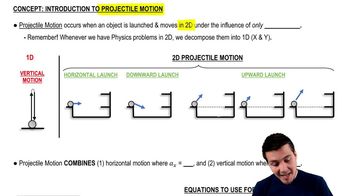
Projectile Motion

Projectile motion refers to the motion of an object that is thrown or projected into the air, subject to the force of gravity. In this scenario, the package dropped from the plane will follow a parabolic trajectory due to gravitational acceleration acting on it. Understanding the principles of projectile motion is essential to calculate how far the package will travel horizontally while falling.
추천 영상:
가이드 코스
04:44
Introduction to Projectile Motion

Time of Flight

The time of flight is the duration an object remains in the air after being projected until it reaches the ground. For the package dropped from the plane, this can be calculated using the height from which it is dropped and the acceleration due to gravity. Knowing the time of flight allows us to determine how far the package will travel horizontally before hitting the ground.
추천 영상:
가이드 코스
05:59
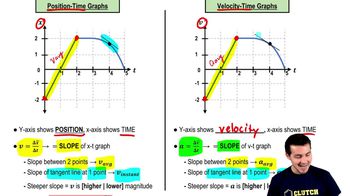
Velocity-Time Graphs & Acceleration

Horizontal Distance

Horizontal distance in projectile motion is the distance an object travels along the horizontal axis while it is in the air. This distance can be calculated by multiplying the horizontal speed of the plane by the time of flight. In this problem, it is crucial to find the horizontal distance to determine how far short of the target the package will land.
추천 영상:
가이드 코스
08:37
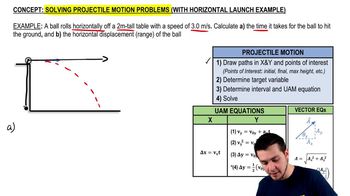
Solving Horizontal Launch Problems
관련 실천
교과서 질문

You have a remote-controlled car that has been programmed to have velocity v=(3ti+2t2j)m/s\(\mathbf{v}\) = (-3t\(\mathbf{i}\) + 2t^2\(\mathbf{j}\)) \, \(\text{m/s}\), where t is in s. At t = 0 s, the car is at r0=(3.0i+2.0j)m\(\mathbf{r}\)_0 = (3.0\(\mathbf{i}\) + 2.0\(\mathbf{j}\)) \, \(\text{m}\). What are the car's position vector?

1941
views

교과서 질문

A particle's trajectory is described by x=(12t32t2)mandy=(12t22t)m,x = \(\left\)(\(\frac{1}{2}\) t^3 - 2t^2\(\right\)) \, \(\text{m}\) \(\quad\) \(\text{and}\) \(\quad\) y = \(\left\)(\(\frac{1}{2}\) t^2 - 2t\(\right\)) \, \(\text{m}\), where tt is in ss. What are the particle's position and speed at t=0 st=0\(\text{ s}\) and t=4 st=4\(\text{ s}\)?

2966
views
1
rank
교과서 질문

A rifle is aimed horizontally at a target 50 m away. The bullet hits the target 2.0 cm below the aim point. (b) What was the bullet's speed as it left the barrel?

2516
views
교과서 질문

A particle's trajectory is described by x=(12t32t2)mandy=(12t22t)m,x = \(\left\)(\(\frac{1}{2}\) t^3 - 2t^2\(\right\)) \, \(\text{m}\) \(\quad\) \(\text{and}\) \(\quad\) y = \(\left\)(\(\frac{1}{2}\) t^2 - 2t\(\right\)) \, \(\text{m}\), where tt is in ss. What is the particle's direction of motion, measured as an angle from the xx-axis, at t=0 st=0\(\text{ s}\) and t=4 st=4\(\text{ s}\)?

403
views
교과서 질문

A physics student on Planet Exidor throws a ball, and it follows the parabolic trajectory shown in FIGURE EX4.13. The ball's position is shown at 1 s intervals until t = 3s. At t = 1s, the ball's velocity is v = (2.0 i + 2.0 j) m/s. Determine the ball's velocity at t = 0 s, 2s, and 3s.

2732
views
1
rank
교과서 질문

A physics student on Planet Exidor throws a ball, and it follows the parabolic trajectory shown in FIGURE EX4.13. The ball's position is shown at 1 s intervals until t = 3s. At t = 1s, the ball's velocity is v = (2.0 i + 2.0 j) m/s. What is the value of g on Planet Exidor?

2625
views