
Ch 04: Kinematics in Two Dimensions
Knight Calc - Physics for Scientists and Engineers 5th Edition
Knight Calc5th EditionPhysics for Scientists and EngineersISBN: 9780137344796당신이 사용하는 게 아니라요?교과서 변경
4장, 문제 65a

A typical laboratory centrifuge rotates at 4000 rpm. Test tubes have to be placed into a centrifuge very carefully because of the very large accelerations. What is the acceleration at the end of a test tube that is 10 cm from the axis of rotation?

검증된 단계별 안내
1
Step 1: Convert the rotational speed from revolutions per minute (rpm) to angular velocity in radians per second. Use the formula \( \omega = \frac{2\pi \cdot \text{rpm}}{60} \), where \( \omega \) is the angular velocity.
Step 2: Identify the radius of rotation, which is the distance from the axis of rotation to the end of the test tube. In this case, the radius \( r \) is given as 10 cm. Convert this to meters by dividing by 100, so \( r = 0.1 \, \text{m} \).
Step 3: Use the formula for centripetal acceleration \( a_c = \omega^2 \cdot r \), where \( a_c \) is the centripetal acceleration, \( \omega \) is the angular velocity, and \( r \) is the radius.
Step 4: Substitute the values of \( \omega \) (calculated in Step 1) and \( r \) (converted in Step 2) into the formula \( a_c = \omega^2 \cdot r \).
Step 5: Simplify the expression to find the centripetal acceleration \( a_c \). Ensure the units are consistent (meters per second squared for acceleration).

비슷한 문제에 대한 검증된 영상 답변:

이 영상 해법은 위 문제에 도움이 된다고 튜터들이 추천한 것입니다.
영상 길이:
3m
도움이 되었나요?

주요 개념

질문에 올바르게 답하기 위해 반드시 이해해야 하는 핵심 개념들은 다음과 같습니다.

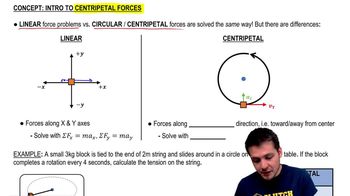
Centripetal Acceleration

Centripetal acceleration is the acceleration directed towards the center of a circular path that an object follows. It is necessary for maintaining circular motion and is calculated using the formula a = v²/r, where v is the tangential velocity and r is the radius of the circular path. In the context of a centrifuge, this acceleration increases with the distance from the axis of rotation.
추천 영상:
가이드 코스
06:48
Intro to Centripetal Forces

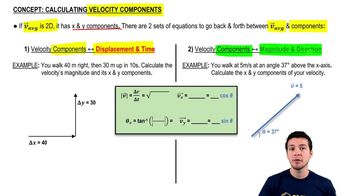
Tangential Velocity

Tangential velocity is the linear speed of an object moving along a circular path, measured at a point tangent to the circle. It can be calculated from the rotational speed (in revolutions per minute) and the radius of the circular path. For a centrifuge, the tangential velocity at the end of a test tube can be derived from the rotation speed and the distance from the axis.
추천 영상:
가이드 코스
05:53
Calculating Velocity Components

Rotational Motion

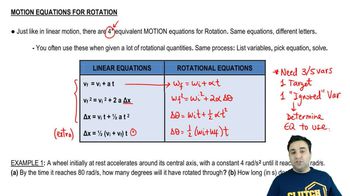
Rotational motion refers to the motion of an object that rotates around an axis. In a centrifuge, the test tubes experience rotational motion, which results in forces acting on the contents due to the rotation. Understanding the principles of rotational motion, including angular velocity and acceleration, is essential for calculating the effects of this motion on the test tubes.
추천 영상:
가이드 코스
07:18
Equations of Rotational Motion
관련 실천
교과서 질문

While driving north at 25 m/s during a rainstorm you notice that the rain makes an angle of 38° with the vertical. While driving back home moments later at the same speed but in the opposite direction, you see that the rain is falling straight down. From these observations, determine the speed and angle of the raindrops relative to the ground.

2314
views
교과서 질문

A Ferris wheel of radius R speeds up with angular acceleration starting from rest. Find expressions for the (a) velocity and (b) centripetal acceleration of a rider after the Ferris wheel has rotated through angle ∆θ.

1854
views
교과서 질문

The angular velocity of a spinning gyroscope is measured every 0.5 s. The results and the best-fit line from a spreadsheet are shown in FIGURE P4.63. What is the gyroscope's initial angular velocity at t = 0 s?

2287
views
교과서 질문

A typical laboratory centrifuge rotates at 4000 rpm. Test tubes have to be placed into a centrifuge very carefully because of the very large accelerations. For comparison, what is the magnitude of the acceleration a test tube would experience if dropped from a height of 1.0 m and stopped in a 1.0-ms-long encounter with a hard floor?

1438
views
교과서 질문

Communications satellites are placed in a circular orbit where they stay directly over a fixed point on the equator as the earth rotates. These are called geosynchronous orbits. The radius of the earth is 6.37 x 10⁶ m, and the altitude of a geosynchronous orbit is 3.58 x 10⁷ m (≈ 22,000 miles). What are (a) the speed and (b) the magnitude of the acceleration of a satellite in a geosynchronous orbit?

3292
views
교과서 질문

A ball rolling on a circular track, starting from rest, has angular acceleration α\(\alpha\). Find an expression, in terms of α\(\alpha\), for the time at which the ball's acceleration vector a is 4545^{\(\circ\)} away from a radial line toward the center of the circle.

1812
views