
Ch 04: Kinematics in Two Dimensions
Knight Calc - Physics for Scientists and Engineers 5th Edition
Knight Calc5th EditionPhysics for Scientists and EngineersISBN: 9780137344796당신이 사용하는 게 아니라요?교과서 변경
4장, 문제 65b

A typical laboratory centrifuge rotates at 4000 rpm. Test tubes have to be placed into a centrifuge very carefully because of the very large accelerations. For comparison, what is the magnitude of the acceleration a test tube would experience if dropped from a height of 1.0 m and stopped in a 1.0-ms-long encounter with a hard floor?

검증된 단계별 안내
1
Step 1: Start by calculating the velocity of the test tube just before it hits the floor. Use the kinematic equation for free fall: v=2gh, where g is the acceleration due to gravity (9.8 m/s²) and h is the height (1.0 m).
Step 2: Once the velocity v is determined, calculate the deceleration (negative acceleration) experienced by the test tube when it comes to a stop. Use the formula: a=vt, where t is the stopping time (1.0 ms or 0.001 s).
Step 3: Substitute the value of v from Step 1 and the stopping time t into the formula for a to calculate the magnitude of the deceleration.
Step 4: Recognize that the deceleration is much larger than the acceleration due to gravity, which is why the test tube must be handled carefully to avoid damage.
Step 5: Compare the calculated deceleration to the acceleration experienced in the centrifuge (from part a of the problem, if available) to understand the relative magnitudes of these forces.

비슷한 문제에 대한 검증된 영상 답변:

이 영상 해법은 위 문제에 도움이 된다고 튜터들이 추천한 것입니다.
영상 길이:
7m
도움이 되었나요?

주요 개념

질문에 올바르게 답하기 위해 반드시 이해해야 하는 핵심 개념들은 다음과 같습니다.

Centrifugal Acceleration

Centrifugal acceleration is the apparent force that draws a rotating object away from the center of rotation, experienced by objects in a rotating system, such as a centrifuge. It is calculated using the formula a = ω²r, where ω is the angular velocity in radians per second and r is the radius of the circular path. In a centrifuge, this acceleration can be significantly larger than gravitational acceleration, leading to the need for careful placement of test tubes.
추천 영상:
가이드 코스
05:47
Intro to Acceleration

Free Fall and Impact Acceleration

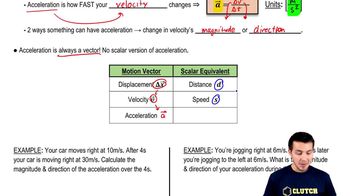
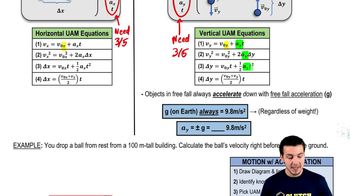
When an object is dropped from a height, it accelerates due to gravity until it impacts the ground. The acceleration during free fall is approximately 9.81 m/s², but the impact acceleration can be much greater depending on how quickly the object comes to a stop. In this scenario, the test tube experiences a rapid deceleration over a short time (1.0 ms), which can result in a very high magnitude of acceleration upon impact.
추천 영상:
가이드 코스
08:36
Vertical Motion & Free Fall

Impulse and Momentum

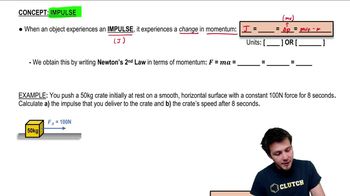
Impulse is the change in momentum of an object when a force is applied over a period of time. It is calculated as the product of the average force and the time duration of the force application. In the context of the test tube dropping and stopping, the impulse experienced during the brief encounter with the floor is crucial for determining the force exerted on the test tube and the resulting acceleration, which can be calculated using the impulse-momentum theorem.
추천 영상:
가이드 코스
06:00
Impulse & Impulse-Momentum Theorem
관련 실천
교과서 질문

A computer hard disk 8.0 cm in diameter is initially at rest. A small dot is painted on the edge of the disk. The disk accelerates at 600 rad/s² for ½ s, then coasts at a steady angular velocity for another ½ s. Through how many revolutions has the disk turned?

1757
views
교과서 질문

A Ferris wheel of radius R speeds up with angular acceleration starting from rest. Find expressions for the (a) velocity and (b) centripetal acceleration of a rider after the Ferris wheel has rotated through angle ∆θ.

1854
views
교과서 질문

A typical laboratory centrifuge rotates at 4000 rpm. Test tubes have to be placed into a centrifuge very carefully because of the very large accelerations. What is the acceleration at the end of a test tube that is 10 cm from the axis of rotation?

2110
views
1
rank
교과서 질문

The angular velocity of a spinning gyroscope is measured every 0.5 s. The results and the best-fit line from a spreadsheet are shown in FIGURE P4.63. What is the gyroscope's initial angular velocity at t = 0 s?

2287
views
교과서 질문

Communications satellites are placed in a circular orbit where they stay directly over a fixed point on the equator as the earth rotates. These are called geosynchronous orbits. The radius of the earth is 6.37 x 10⁶ m, and the altitude of a geosynchronous orbit is 3.58 x 10⁷ m (≈ 22,000 miles). What are (a) the speed and (b) the magnitude of the acceleration of a satellite in a geosynchronous orbit?

3292
views
교과서 질문

A ball rolling on a circular track, starting from rest, has angular acceleration α\(\alpha\). Find an expression, in terms of α\(\alpha\), for the time at which the ball's acceleration vector a is 4545^{\(\circ\)} away from a radial line toward the center of the circle.

1812
views