Ch 04: Kinematics in Two Dimensions
Knight Calc - Physics for Scientists and Engineers 5th Edition
Knight Calc5th EditionPhysics for Scientists and EngineersISBN: 9780137344796당신이 사용하는 게 아니라요?교과서 변경
4장, 문제 78a

In Problems 78, 79, and 80 you are given the equations that are used to solve a problem. For each of these, you are to write a realistic problem for which these are the correct equations. Be sure that the answer your problem requests is consistent with the equations given.
100m=0m+(50cosθm/s)t10m=0m+(50sinθm/s)t112(9.80m/s2)t12\(\begin{aligned}\) 100 \, \(\text{m}\) &= 0 \, \(\text{m}\) + (50 \(\cos\) \(\theta\) \, \(\text{m/s}\)) t_1 \\ 0 \, \(\text{m}\) &= 0 \, \(\text{m}\) + (50 \(\sin\) \(\theta\) \, \(\text{m/s}\)) t_1 - \(\frac{1}{2}\) (9.80 \, \(\text{m/s}\)^2) t_1^2 \(\end{aligned}\)

검증된 단계별 안내
1
Step 1: Analyze the given equations. The first equation, 100 m = 0 m + (50cos⁡θ m/s)t₁, represents the horizontal motion of a projectile, where the horizontal displacement is 100 m, the initial horizontal velocity is (50cosθ) m/s, and t₁ is the time of flight. The second equation, 0 m = 0 m + (50sin⁡θ m/s)t₁ - (1/2)(9.80 m/s²)t₁², represents the vertical motion of the projectile, where the vertical displacement is 0 m (it returns to the same vertical level), the initial vertical velocity is (50sinθ) m/s, and the acceleration due to gravity is -9.80 m/s².

Step 2: Recognize the type of problem. These equations describe the motion of a projectile launched at an angle θ with an initial velocity of 50 m/s. The horizontal displacement is 100 m, and the projectile lands back at the same vertical level from which it was launched. The problem likely involves finding the angle θ or the time of flight t₁.
Step 3: Set up a realistic problem. A possible problem could be: 'A ball is launched from the ground with an initial velocity of 50 m/s at an angle θ above the horizontal. The ball travels a horizontal distance of 100 m before landing back on the ground. Determine the angle θ at which the ball was launched and the time of flight t₁.'
Step 4: Solve for time of flight t₁ using the horizontal motion equation. Rearrange the first equation to isolate t₁: t₁ = 100 m / (50cosθ m/s). This equation relates the time of flight to the horizontal velocity component and the horizontal displacement.
Step 5: Substitute t₁ into the vertical motion equation to solve for θ. Replace t₁ in the second equation with the expression derived in Step 4. This will result in an equation involving θ that can be solved using trigonometric identities or numerical methods. The solution will yield the angle θ that satisfies both the horizontal and vertical motion equations.

비슷한 문제에 대한 검증된 영상 답변:

이 영상 해법은 위 문제에 도움이 된다고 튜터들이 추천한 것입니다.
도움이 되었나요?

주요 개념

질문에 올바르게 답하기 위해 반드시 이해해야 하는 핵심 개념들은 다음과 같습니다.

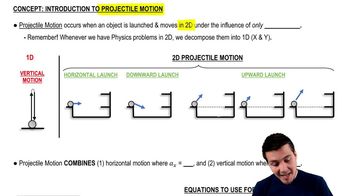
Projectile Motion

Projectile motion refers to the motion of an object that is launched into the air and is subject to the force of gravity. It can be analyzed in two dimensions: horizontal and vertical. The horizontal motion is uniform, while the vertical motion is influenced by gravitational acceleration. Understanding the components of projectile motion is essential for solving problems involving angles and distances, as seen in the given equations.
추천 영상:
가이드 코스
04:44
Introduction to Projectile Motion

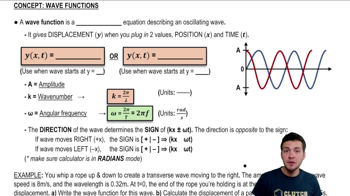
Trigonometric Functions

Trigonometric functions, such as sine and cosine, relate the angles of a triangle to the ratios of its sides. In the context of projectile motion, these functions are used to resolve the initial velocity into horizontal and vertical components. The angle θ in the equations indicates the direction of the launch, and using trigonometric functions allows for the calculation of the object's trajectory and displacement.
추천 영상:
가이드 코스
08:30
Intro to Wave Functions

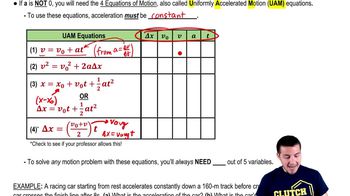
Kinematic Equations

Kinematic equations describe the motion of objects under constant acceleration. They relate displacement, initial velocity, final velocity, acceleration, and time. The equations provided in the question are specific kinematic equations that can be used to determine the position and velocity of a projectile at any given time, making them crucial for formulating realistic problems based on the motion of the object.
추천 영상:
가이드 코스
08:25
Kinematics Equations
관련 실천