

A cannon on a flat railroad car travels to the east with its barrel tilted 30° above horizontal. It fires a cannonball at 50 m/s. At t = 0 s , the car, starting from rest, begins to accelerate to the east at 2.0 m/s². At what time should the cannon be fired to hit a target on the tracks that is 400 m to the east of the car's initial position? Assume that the cannonball is fired from ground level.
Ch 04: Kinematics in Two Dimensions
4장, 문제 83
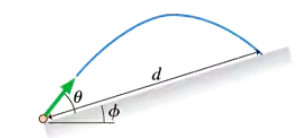
The cannon in FIGURE CP4.83 fires a projectile at launch angle θ with respect to the slope, which is at angle Φ. Find the launch angle that maximizes d. Hint: Choosing the proper coordinate system is essential. There are two options.

검증된 단계별 안내1
Choose a coordinate system where the x-axis is aligned with the slope (inclined at angle Φ) and the y-axis is perpendicular to the slope. This simplifies the problem by reducing the complexity of the motion equations.
Decompose the initial velocity of the projectile into components relative to the chosen coordinate system. The velocity components are: \( v_{x} = v_0 \cos(\theta) \) and \( v_{y} = v_0 \sin(\theta) \), where \( \theta \) is the launch angle relative to the slope.
Write the equations of motion in the chosen coordinate system. For the x-direction: \( x = v_{x} t \). For the y-direction: \( y = v_{y} t - \frac{1}{2} g t^2 \), where \( g \) is the acceleration due to gravity.
Determine the condition for the projectile to land back on the slope. The slope equation in the chosen coordinate system is \( y = x \tan(\Phi) \). Substitute \( x \) and \( y \) from the motion equations into this slope equation to find the time of flight \( t \).
Maximize the range \( d \), which is the distance along the slope. Express \( d \) in terms of \( \theta \), \( \Phi \), and other parameters. Differentiate \( d \) with respect to \( \theta \), set the derivative equal to zero, and solve for the optimal launch angle \( \theta \).

비슷한 문제에 대한 검증된 영상 답변:
이 영상 해법은 위 문제에 도움이 된다고 튜터들이 추천한 것입니다.
영상 길이:
18m도움이 되었나요?
주요 개념
질문에 올바르게 답하기 위해 반드시 이해해야 하는 핵심 개념들은 다음과 같습니다.
Projectile Motion
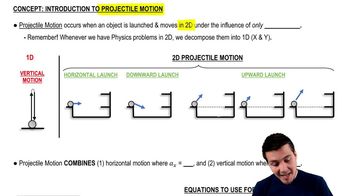
Projectile motion refers to the motion of an object that is launched into the air and is subject to gravitational forces. It can be analyzed in two dimensions, typically horizontal and vertical, where the horizontal motion is uniform and the vertical motion is influenced by gravity. Understanding the trajectory, range, and time of flight of the projectile is crucial for solving problems related to launch angles and distances.
추천 영상:
가이드 코스
Introduction to Projectile Motion
Coordinate Systems
A coordinate system is a framework that allows for the representation of points in space using numerical values. In physics, choosing an appropriate coordinate system simplifies the analysis of motion. For projectile motion on an inclined plane, one can use either a Cartesian coordinate system aligned with the slope or a standard Cartesian system, which can affect the equations of motion and the resulting calculations for launch angles.
추천 영상:
가이드 코스
Coordinates of Center of Mass of 4 objects
Optimization in Physics
Optimization in physics involves finding the best solution or maximum/minimum value of a particular quantity, such as distance or time. In the context of projectile motion, maximizing the distance traveled by a projectile requires analyzing how varying the launch angle affects the range. This often involves using calculus or algebraic methods to derive the conditions under which the distance is maximized, taking into account the angles involved.
추천 영상:
가이드 코스
Introduction to Units & the SI System
관련 실천
교과서 질문
2025
views
교과서 질문
In Problems 78, 79, and 80 you are given the equations that are used to solve a problem. For each of these, you are to write a realistic problem for which these are the correct equations. Be sure that the answer your problem requests is consistent with the equations given.
422
views
교과서 질문
A painted tooth on a spinning gear has angular position θ = (6.0 rad/s⁴)t⁴. What is the tooth's angular acceleration at the end of 10 revolutions?
1935
views
교과서 질문
An archer standing on a 15° slope shoots an arrow 20° above the horizontal, as shown in FIGURE CP4.82. How far down the slope does the arrow hit if it is shot with a speed of 5.0 m/s from 1.75 m above the ground?
299
views
