Ch 05: Force and Motion
Knight Calc - Physics for Scientists and Engineers 5th Edition
Knight Calc5th EditionPhysics for Scientists and EngineersISBN: 9780137344796당신이 사용하는 게 아니라요?교과서 변경
5장, 문제 38a

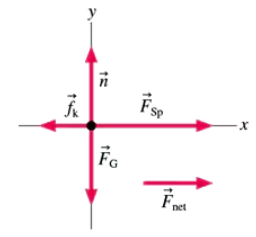
Problems 35, 36, 37, 38, 39, and 40 show a free-body diagram. For each: Identify the direction of the acceleration vector a and show it as a vector next to your diagram. Or, if appropriate, write a = 0.

검증된 단계별 안내
1
Step 1: Analyze the forces in the diagram. The forces shown are: the normal force (n) pointing upward along the y-axis, the gravitational force (Fg) pointing downward along the y-axis, the kinetic friction force (fk) pointing left along the x-axis, and the net force (Fnet) pointing right along the x-axis.
Step 2: Determine the net force in the y-direction. The normal force (n) and gravitational force (Fg) are equal in magnitude but opposite in direction, so they cancel each other out. This means there is no acceleration in the y-direction (a_y = 0).
Step 3: Determine the net force in the x-direction. The net force (Fnet) is pointing to the right, while the kinetic friction force (fk) is pointing to the left. Since Fnet is explicitly labeled, it indicates that the object is accelerating to the right along the x-axis.
Step 4: Conclude the direction of the acceleration vector. Since there is no acceleration in the y-direction and the object is accelerating to the right in the x-direction, the acceleration vector (a) points to the right along the x-axis.
Step 5: Represent the acceleration vector on the diagram. Draw a vector labeled 'a' pointing to the right along the x-axis next to the diagram to indicate the direction of acceleration.

비슷한 문제에 대한 검증된 영상 답변:

이 영상 해법은 위 문제에 도움이 된다고 튜터들이 추천한 것입니다.
영상 길이:
2m
도움이 되었나요?

주요 개념

질문에 올바르게 답하기 위해 반드시 이해해야 하는 핵심 개념들은 다음과 같습니다.

Free-Body Diagram

A free-body diagram is a graphical representation used to visualize the forces acting on an object. It shows all the external forces, including their magnitudes and directions, allowing for a clear analysis of the net force and resulting motion. In this context, the diagram illustrates forces such as normal force (n), kinetic friction (fk), and gravitational force (Fg).
추천 영상:
08:42
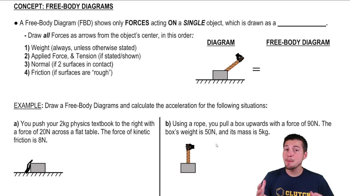
Free-Body Diagrams

Net Force

The net force is the vector sum of all the forces acting on an object. It determines the object's acceleration according to Newton's second law, F_net = ma, where F_net is the net force, m is mass, and a is acceleration. In the provided diagram, the direction of the net force (F_net) indicates the overall influence of the forces on the object's motion.
추천 영상:
06:28
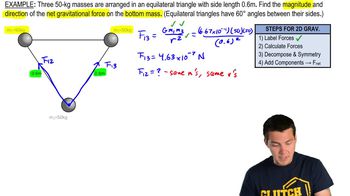
Finding Net Forces in 2D Gravitation

Acceleration Vector

The acceleration vector represents the rate of change of velocity of an object and is directed in the same direction as the net force acting on it. If the net force is zero, the acceleration is also zero (a = 0), indicating that the object is either at rest or moving with constant velocity. Understanding the relationship between net force and acceleration is crucial for analyzing motion in physics.
추천 영상:
06:44
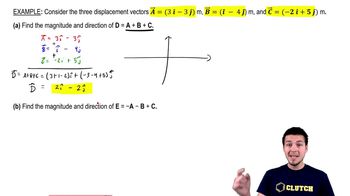
Adding 3 Vectors in Unit Vector Notation