Ch 05: Force and Motion
Knight Calc - Physics for Scientists and Engineers 5th Edition
Knight Calc5th EditionPhysics for Scientists and EngineersISBN: 9780137344796당신이 사용하는 게 아니라요?교과서 변경
5장, 문제 52

Problems 42, 43, 44, 45, 46, 47, 48, 49, 50, 51, and 52 describe a situation. For each, draw a motion diagram, a force-identification diagram, and a free-body diagram. A model rocket is fired straight down from the top of a tower.

검증된 단계별 안내
1
Identify the forces acting on the rocket: The rocket is subject to two primary forces. First, the gravitational force (weight) acts downward due to Earth's gravity. Second, there may be a thrust force from the rocket's engine, which also acts downward since the rocket is fired straight down.
Draw a motion diagram: Represent the rocket's motion with a series of dots indicating its position at successive time intervals. Since the rocket is accelerating downward (due to both gravity and thrust), the spacing between the dots should increase as time progresses.
Create a force-identification diagram: List all the forces acting on the rocket. These include the gravitational force (labeled as \( F_g \)) and the thrust force (labeled as \( F_{thrust} \)). Ensure you clearly identify the direction of each force.
Draw a free-body diagram: Represent the rocket as a single point. Draw vectors to represent the forces acting on it. The gravitational force vector \( F_g \) points downward, and the thrust force vector \( F_{thrust} \) also points downward. The length of each vector should be proportional to the magnitude of the respective force.
Analyze the net force: Since both forces act in the same direction (downward), the net force \( F_{net} \) is the sum of the magnitudes of \( F_g \) and \( F_{thrust} \). This net force causes the rocket to accelerate downward, as described by Newton's second law: \( F_{net} = m \cdot a \), where \( m \) is the mass of the rocket and \( a \) is its acceleration.

비슷한 문제에 대한 검증된 영상 답변:

이 영상 해법은 위 문제에 도움이 된다고 튜터들이 추천한 것입니다.
영상 길이:
3m
도움이 되었나요?

주요 개념

질문에 올바르게 답하기 위해 반드시 이해해야 하는 핵심 개념들은 다음과 같습니다.

Motion Diagrams

A motion diagram visually represents the position of an object at various time intervals, illustrating its trajectory and speed. In the context of the model rocket, it will show the rocket's downward motion from the tower, indicating changes in position over time. This helps in understanding the kinematics involved in the rocket's descent.
추천 영상:
가이드 코스
08:07
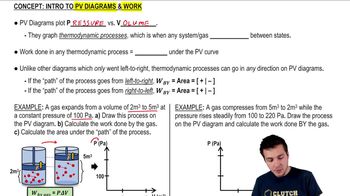
Work and PV Diagrams

Force Identification Diagrams

Force identification diagrams depict all the forces acting on an object at a given moment. For the model rocket, this includes gravitational force pulling it downward and any other forces, such as air resistance. Understanding these forces is crucial for analyzing the rocket's motion and predicting its behavior during descent.
추천 영상:
가이드 코스
08:42
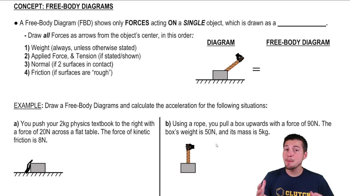
Free-Body Diagrams

Free-Body Diagrams

Free-body diagrams are simplified representations that isolate an object and illustrate all the forces acting on it. In the case of the model rocket, the diagram will show the weight of the rocket acting downward and any opposing forces. This tool is essential for applying Newton's laws of motion to solve problems related to the rocket's acceleration and overall dynamics.
추천 영상:
가이드 코스
08:42
Free-Body Diagrams
관련 실천
교과서 질문

A rubber ball bounces. We'd like to understand how the ball bounces. Draw a free-body diagram of the ball during its contact with the ground. Is there a net force acting on the ball? If so, in which direction?

1389
views

교과서 질문

A rubber ball bounces. We'd like to understand how the ball bounces. A rubber ball has been dropped and is bouncing off the floor. Draw a motion diagram of the ball during the brief time interval that it is in contact with the floor. Show 4 or 5 frames as the ball compresses, then another 4 or 5 frames as it expands. What is the direction of a during each of these parts of the motion?

2126
views
교과서 질문

If a car stops suddenly, you feel 'thrown forward.' We'd like to understand what happens to the passengers as a car stops. Imagine yourself sitting on a very slippery bench inside a car. This bench has no friction, no seat back, and there's nothing for you to hold onto. Draw your free-body diagram. Is there a net force on you? If so, in which direction?

284
views
교과서 질문

Problems 35, 36, 37, 38, 39, and 40 show a free-body diagram. For each: Identify the direction of the acceleration vector a and show it as a vector next to your diagram. Or, if appropriate, write a = 0.

1469
views
교과서 질문

Problems 42, 43, 44, 45, 46, 47, 48, 49, 50, 51, and 52 describe a situation. For each, draw a motion diagram, a force-identification diagram, and a free-body diagram. A rocket is being launched straight up. Air resistance is not negligible.

1413
views
교과서 질문

Problems 42, 43, 44, 45, 46, 47, 48, 49, 50, 51, and 52 describe a situation. For each, draw a motion diagram, a force-identification diagram, and a free-body diagram. A Styrofoam ball has just been shot straight up. Air resistance is not negligible.

1444
views