Ch 06: Dynamics I: Motion Along a Line
Knight Calc - Physics for Scientists and Engineers 5th Edition
Knight Calc5th EditionPhysics for Scientists and EngineersISBN: 9780137344796당신이 사용하는 게 아니라요?교과서 변경
6장, 문제 78c

A 1.0-cm-diameter, 2.0 g marble is shot horizontally into a tank of 20°C olive oil at 10 cm/s. How far in cm will it travel before stopping?

검증된 단계별 안내
1
Determine the forces acting on the marble as it moves through the olive oil. The primary force opposing its motion is the drag force, which can be expressed as \( F_d = \frac{1}{2} C_d \rho A v^2 \), where \( C_d \) is the drag coefficient, \( \rho \) is the density of the fluid (olive oil), \( A \) is the cross-sectional area of the marble, and \( v \) is its velocity.
Calculate the cross-sectional area \( A \) of the marble using the formula for the area of a circle: \( A = \pi r^2 \), where \( r \) is the radius of the marble. The radius can be found by dividing the diameter (1.0 cm) by 2.
Write the equation of motion for the marble. The net force acting on the marble is \( F = ma \), where \( m \) is the mass of the marble and \( a \) is its acceleration. Since the drag force is the only force acting in the horizontal direction, \( ma = -F_d \). Substitute \( F_d \) into this equation to express the acceleration in terms of velocity: \( a = -\frac{1}{2m} C_d \rho A v^2 \).
Recognize that the velocity \( v \) decreases over time due to the drag force. Use the relationship between acceleration and velocity: \( a = \frac{dv}{dt} \). Substitute \( a \) from the previous step into this equation to obtain \( \frac{dv}{dt} = -\frac{1}{2m} C_d \rho A v^2 \). Rearrange to separate variables: \( \frac{dv}{v^2} = -\frac{1}{2m} C_d \rho A dt \).
Integrate both sides of the equation to find the distance traveled by the marble before it stops. The left-hand side integrates with respect to velocity from \( v = 10 \ \text{cm/s} \) to \( v = 0 \), and the right-hand side integrates with respect to time. After solving for time, use the relationship \( v = \frac{dx}{dt} \) to find the total distance traveled by the marble.

비슷한 문제에 대한 검증된 영상 답변:

이 영상 해법은 위 문제에 도움이 된다고 튜터들이 추천한 것입니다.
영상 길이:
7m
도움이 되었나요?

주요 개념

질문에 올바르게 답하기 위해 반드시 이해해야 하는 핵심 개념들은 다음과 같습니다.

Drag Force

The drag force is the resistance experienced by an object moving through a fluid, such as olive oil. It depends on the object's velocity, the fluid's density, and the object's cross-sectional area. The drag force acts opposite to the direction of motion and increases with speed, ultimately affecting how far the marble will travel before stopping.
추천 영상:
가이드 코스
06:48
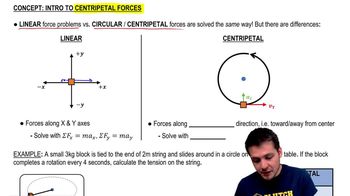
Intro to Centripetal Forces

Terminal Velocity

Terminal velocity is the constant speed an object reaches when the drag force equals the gravitational force acting on it, resulting in no net acceleration. In this scenario, the marble will decelerate due to drag until it reaches a point where the forces balance, which is crucial for determining how far it will travel in the olive oil.
추천 영상:
가이드 코스
7:27
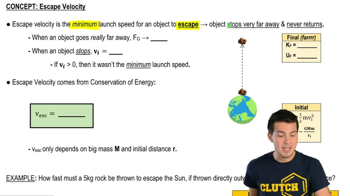
Escape Velocity

Kinematic Equations

Kinematic equations describe the motion of objects under constant acceleration. They relate displacement, initial velocity, final velocity, acceleration, and time. In this problem, these equations can be used to calculate the distance the marble travels before coming to a stop, taking into account the deceleration caused by the drag force.
추천 영상:
가이드 코스
08:25
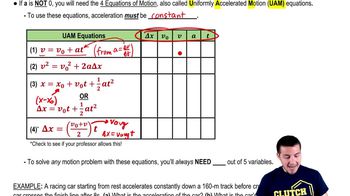
Kinematics Equations