Ch 06: Dynamics I: Motion Along a Line
Knight Calc - Physics for Scientists and Engineers 5th Edition
Knight Calc5th EditionPhysics for Scientists and EngineersISBN: 9780137344796당신이 사용하는 게 아니라요?교과서 변경
6장, 문제 77b

A 4.0-cm-diameter, 55 g ball is shot horizontally into a tank of 40°C honey. How long will it take for the horizontal speed to decrease to 10% of its initial value?

검증된 단계별 안내
1
Step 1: Identify the forces acting on the ball as it moves through the honey. The primary force is the drag force, which depends on the viscosity of the honey and the velocity of the ball. The drag force can be expressed as \( F_d = 6 \pi \eta r v \), where \( \eta \) is the dynamic viscosity of the honey, \( r \) is the radius of the ball, and \( v \) is the velocity of the ball.
Step 2: Relate the drag force to the deceleration of the ball using Newton's second law. The net force acting on the ball is \( F_d = m a \), where \( m \) is the mass of the ball and \( a \) is its acceleration. Since \( a = \frac{dv}{dt} \), substitute \( F_d \) into the equation to get \( 6 \pi \eta r v = m \frac{dv}{dt} \).
Step 3: Rearrange the equation to isolate \( \frac{dv}{v} \) on one side and \( dt \) on the other side. This gives \( \frac{dv}{v} = -\frac{6 \pi \eta r}{m} dt \). Note the negative sign, which indicates that the velocity is decreasing over time.
Step 4: Integrate both sides of the equation to find the time \( t \) it takes for the velocity to decrease to 10% of its initial value. The limits of integration for \( v \) are \( v_0 \) (initial velocity) to \( 0.1 v_0 \), and for \( t \), the limits are \( 0 \) to \( t \). The integral becomes \( \int_{v_0}^{0.1v_0} \frac{1}{v} dv = -\int_{0}^{t} \frac{6 \pi \eta r}{m} dt \).
Step 5: Solve the integral to find \( t \). The left-hand side evaluates to \( \ln(0.1) - \ln(v_0) \), and the right-hand side evaluates to \( -\frac{6 \pi \eta r}{m} t \). Rearrange to solve for \( t \): \( t = \frac{-\ln(0.1)}{\frac{6 \pi \eta r}{m}} \). Substitute the given values for \( \eta \) (viscosity of honey at 40°C), \( r \) (radius of the ball), and \( m \) (mass of the ball) to compute the time.

비슷한 문제에 대한 검증된 영상 답변:

이 영상 해법은 위 문제에 도움이 된다고 튜터들이 추천한 것입니다.
영상 길이:
10m
도움이 되었나요?

주요 개념

질문에 올바르게 답하기 위해 반드시 이해해야 하는 핵심 개념들은 다음과 같습니다.

Drag Force

The drag force is the resistance experienced by an object moving through a fluid, such as honey. It depends on the object's speed, shape, and the fluid's properties, including viscosity. As the ball moves through the honey, the drag force will act opposite to its motion, causing it to decelerate. Understanding this force is crucial for calculating how long it takes for the ball's speed to decrease.
추천 영상:
가이드 코스
06:48
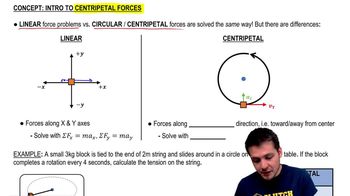
Intro to Centripetal Forces

Viscosity

Viscosity is a measure of a fluid's resistance to flow and deformation. In this scenario, honey's high viscosity significantly affects the ball's motion, as it creates a greater drag force compared to less viscous fluids. The viscosity of the honey will determine how quickly the ball slows down, making it an essential factor in the analysis of the problem.
추천 영상:
가이드 코스
03:41
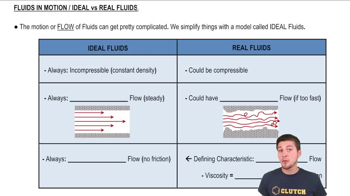
Ideal vs Real Fluids

Kinematics

Kinematics is the branch of mechanics that deals with the motion of objects without considering the forces that cause the motion. In this context, kinematic equations can be used to relate the initial speed of the ball, its final speed, and the time taken to reach that speed. Understanding kinematics is vital for determining how long it takes for the ball's speed to decrease to 10% of its initial value.
추천 영상:
가이드 코스
08:25
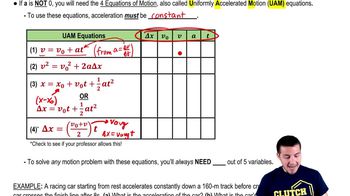
Kinematics Equations