Ch 08: Dynamics II: Motion in a Plane
Knight Calc - Physics for Scientists and Engineers 5th Edition
Knight Calc5th EditionPhysics for Scientists and EngineersISBN: 9780137344796당신이 사용하는 게 아니라요?교과서 변경
8장, 문제 17c

Communications satellites are placed in circular orbits where they stay directly over a fixed point on the equator as the Earth rotates. These are called geosynchronous orbits. The altitude of a geosynchronous orbit is 3.58 x 10⁷ m (approximately 22,00 miles). Astronomical data are inside the back cover of the book. What is the weight of a 2000 kg satellite in a geosynchronous orbit?

검증된 단계별 안내
1
Step 1: Understand the problem. The weight of an object in orbit is the gravitational force acting on it. The formula for gravitational force is given by: F=GmMr2, where G is the gravitational constant, m is the mass of the satellite, M is the mass of the Earth, and r is the distance from the center of the Earth to the satellite.
Step 2: Calculate the distance r from the center of the Earth to the satellite. This is the sum of the Earth's radius and the altitude of the geosynchronous orbit. Use the Earth's radius R=6.37×10⁶ m and the altitude of the orbit h=3.58×10⁷ m. Add these values: r=R+h.
Step 3: Substitute the known values into the gravitational force formula. Use G=6.674×10⁻¹¹ Nm2, M=5.97×1024 kg, and the mass of the satellite m=2000 kg. The formula becomes: F=6.674×10-11×2000×5.97×10246.37×106+3.58×1072.
Step 4: Simplify the denominator by squaring the total distance r. Then, simplify the numerator by multiplying the constants and masses together.
Step 5: Divide the simplified numerator by the simplified denominator to find the gravitational force F, which represents the weight of the satellite in the geosynchronous orbit.

비슷한 문제에 대한 검증된 영상 답변:

이 영상 해법은 위 문제에 도움이 된다고 튜터들이 추천한 것입니다.
영상 길이:
2m
도움이 되었나요?

주요 개념

질문에 올바르게 답하기 위해 반드시 이해해야 하는 핵심 개념들은 다음과 같습니다.

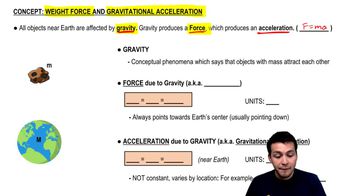
Weight and Gravitational Force

Weight is the force exerted on an object due to gravity, calculated as the product of mass and the acceleration due to gravity (W = mg). In a geosynchronous orbit, the gravitational force acting on the satellite is balanced by the centripetal force required to keep it in circular motion, allowing it to maintain a stable position relative to the Earth's surface.
추천 영상:
가이드 코스
07:32
Weight Force & Gravitational Acceleration

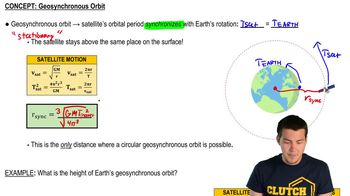
Geosynchronous Orbit

A geosynchronous orbit is a circular orbit around the Earth where a satellite's orbital period matches the Earth's rotation period of approximately 24 hours. This allows the satellite to remain fixed over a specific point on the equator, making it ideal for communication purposes, as it can continuously cover the same area.
추천 영상:
가이드 코스
04:45
Geosynchronous Orbits

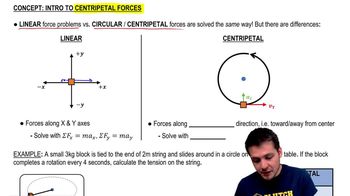
Centripetal Force

Centripetal force is the net force required to keep an object moving in a circular path, directed towards the center of the circle. For a satellite in geosynchronous orbit, this force is provided by the gravitational pull of the Earth, which must equal the required centripetal force to maintain the satellite's circular motion at that altitude.
추천 영상:
가이드 코스
06:48
Intro to Centripetal Forces