Ch 08: Dynamics II: Motion in a Plane
Knight Calc - Physics for Scientists and Engineers 5th Edition
Knight Calc5th EditionPhysics for Scientists and EngineersISBN: 9780137344796당신이 사용하는 게 아니라요?교과서 변경
8장, 문제 20

The weight of passengers on a roller coaster increases by 50% as the car goes through a dip with a 30 m radius of curvature. What is the car's speed at the bottom of the dip?

검증된 단계별 안내
1
Understand the problem: The weight of the passengers increases by 50% at the bottom of the dip due to the centripetal force acting on them. This means the normal force (apparent weight) is 1.5 times the gravitational force. We need to find the speed of the roller coaster car at this point.
Write the forces acting on the passengers at the bottom of the dip: The normal force \( F_n \) and the gravitational force \( F_g = m g \) act upward and downward, respectively. The net force provides the centripetal force \( F_c \), which is \( \frac{m v^2}{r} \), where \( m \) is the mass, \( v \) is the speed, and \( r \) is the radius of curvature.
Set up the equation for the forces: At the bottom of the dip, the normal force is greater than the gravitational force. The net force is \( F_n - F_g = F_c \). Substituting \( F_c \), we get \( F_n - m g = \frac{m v^2}{r} \).
Relate the normal force to the apparent weight: Since the apparent weight is 1.5 times the gravitational force, \( F_n = 1.5 m g \). Substitute this into the equation: \( 1.5 m g - m g = \frac{m v^2}{r} \).
Simplify and solve for \( v \): Combine terms on the left-hand side to get \( 0.5 m g = \frac{m v^2}{r} \). Cancel \( m \) from both sides (assuming \( m \neq 0 \)) and solve for \( v \): \( v = \sqrt{0.5 g r} \). Substitute \( g = 9.8 \, \text{m/s}^2 \) and \( r = 30 \, \text{m} \) to find the speed.

비슷한 문제에 대한 검증된 영상 답변:

이 영상 해법은 위 문제에 도움이 된다고 튜터들이 추천한 것입니다.
영상 길이:
6m
도움이 되었나요?

주요 개념

질문에 올바르게 답하기 위해 반드시 이해해야 하는 핵심 개념들은 다음과 같습니다.

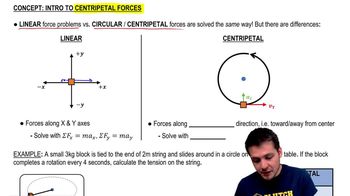
Centripetal Force

Centripetal force is the net force required to keep an object moving in a circular path, directed towards the center of the circle. In the context of the roller coaster, as the car goes through the dip, the gravitational force and the normal force from the track provide the necessary centripetal force to maintain circular motion. The relationship between these forces is crucial for determining the speed of the car at the bottom of the dip.
추천 영상:
가이드 코스
06:48
Intro to Centripetal Forces

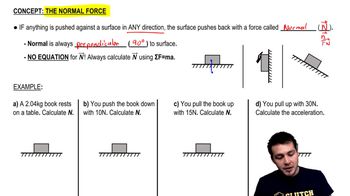
Weight and Normal Force

Weight is the force exerted by gravity on an object, calculated as the product of mass and gravitational acceleration. At the bottom of the dip, the normal force acting on the passengers increases due to the additional centripetal force required for circular motion. The problem states that the weight increases by 50%, indicating that the normal force is greater than the gravitational force, which is essential for calculating the car's speed.
추천 영상:
가이드 코스
08:17
The Normal Force

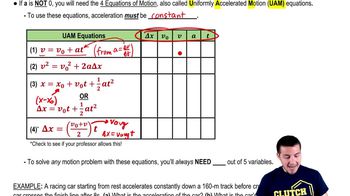
Kinematic Equations

Kinematic equations describe the motion of objects under constant acceleration. In this scenario, the relationship between speed, radius of curvature, and forces acting on the roller coaster can be analyzed using these equations. By applying the principles of circular motion and the forces involved, one can derive the speed of the car at the bottom of the dip, which is essential for solving the problem.
추천 영상:
가이드 코스
08:25
Kinematics Equations
관련 실천
교과서 질문

The normal force equals the magnitude of the gravitational force as a roller-coaster car crosses the top of a 40-m-diameter loop-the-loop. What is the car's speed at the top?

2187
views

교과서 질문

A car drives over the top of a hill that has a radius of 50 m. What maximum speed can the car have at the top without flying off the road?

2776
views
1
rank
교과서 질문

A 500 g ball moves in a vertical circle on a 102-cm-long string. If the speed at the top is 4.0 m/s, then the speed at the bottom will be 7.5 m/s. (You'll learn how to show this in Chapter 10.) What is the tension in the string when the ball is at the top?

1966
views
교과서 질문

Communications satellites are placed in circular orbits where they stay directly over a fixed point on the equator as the Earth rotates. These are called geosynchronous orbits. The altitude of a geosynchronous orbit is 3.58 x 10⁷ m (approximately 22,00 miles). Astronomical data are inside the back cover of the book. What is the weight of a 2000 kg satellite in a geosynchronous orbit?

816
views
교과서 질문

Communications satellites are placed in circular orbits where they stay directly over a fixed point on the equator as the Earth rotates. These are called geosynchronous orbits. The altitude of a geosynchronous orbit is 3.58 x 10⁷ m (approximately 22,00 miles). Astronomical data are inside the back cover of the book. Find the value of g at this altitude.

1053
views
교과서 질문

A 500 g ball moves in a vertical circle on a 102-cm-long string. If the speed at the top is 4.0 m/s, then the speed at the bottom will be 7.5 m/s. (You'll learn how to show this in Chapter 10.) What is the gravitational force acting on the ball?

1362
views