
Ch 09: Work and Kinetic Energy
Knight Calc - Physics for Scientists and Engineers 5th Edition
Knight Calc5th EditionPhysics for Scientists and EngineersISBN: 9780137344796당신이 사용하는 게 아니라요?교과서 변경
9장, 문제 59

A spring of equilibrium length L₁ and spring constant k₁ hangs from the ceiling. Mass m₁ is suspended from its lower end. Then a second spring, with equilibrium length L₂ and spring constant k₂, is hung from the bottom of m₁. Mass m₂ is suspended from this second spring. How far is m₂ below the ceiling?

검증된 단계별 안내
1
Step 1: Understand the system. The problem involves two springs and two masses. The first spring (spring 1) has an equilibrium length L₁ and spring constant k₁, and it supports mass m₁. The second spring (spring 2) has an equilibrium length L₂ and spring constant k₂, and it supports mass m₂. The goal is to find the total distance from the ceiling to mass m₂ when the system is in equilibrium.
Step 2: Analyze the forces acting on mass m₁. At equilibrium, the upward force exerted by spring 1 equals the downward gravitational force on mass m₁ plus the force exerted by spring 2 due to the weight of mass m₂. Mathematically, this can be expressed as: k1 ( x1 ) = m1 g + k2 ( x2 ) where x₁ is the extension of spring 1 and x₂ is the extension of spring 2.
Step 3: Analyze the forces acting on mass m₂. At equilibrium, the upward force exerted by spring 2 equals the downward gravitational force on mass m₂. This can be expressed as: k2 ( x2 ) = m2 g Solve this equation to find x₂, the extension of spring 2.
Step 4: Substitute the value of x₂ into the equation from Step 2 to solve for x₁, the extension of spring 1. This will give you the total extension of spring 1 due to the combined forces of m₁ and the force transmitted by spring 2.
Step 5: Calculate the total distance from the ceiling to mass m₂. This is the sum of the equilibrium lengths of both springs (L₁ and L₂) and their respective extensions (x₁ and x₂). Mathematically: Distance = L1 + x1 + L2 + x2 This will give the total distance of m₂ below the ceiling.

비슷한 문제에 대한 검증된 영상 답변:

이 영상 해법은 위 문제에 도움이 된다고 튜터들이 추천한 것입니다.
영상 길이:
5m
도움이 되었나요?

주요 개념

질문에 올바르게 답하기 위해 반드시 이해해야 하는 핵심 개념들은 다음과 같습니다.

Hooke's Law

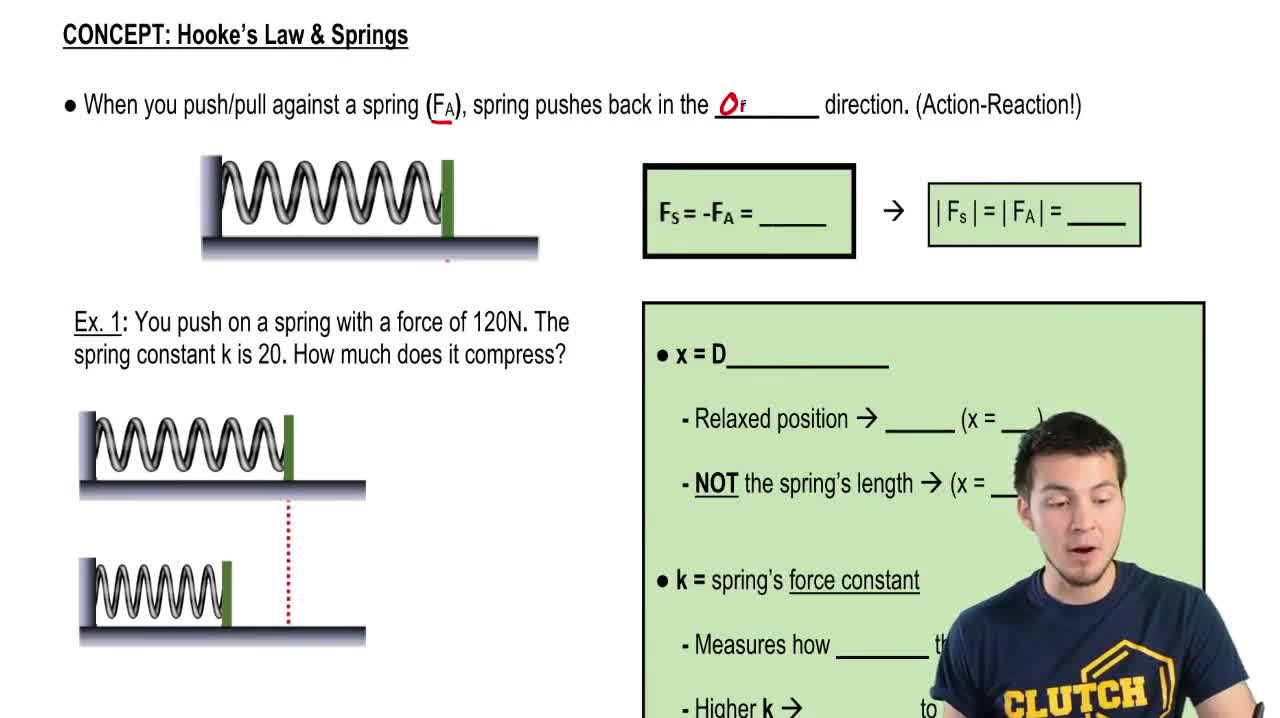
Hooke's Law states that the force exerted by a spring is directly proportional to its extension or compression from its equilibrium position, mathematically expressed as F = -kx, where F is the force, k is the spring constant, and x is the displacement. This principle is essential for understanding how the springs in the problem will stretch under the weight of the masses attached to them.
추천 영상:
05:27
Spring Force (Hooke's Law)

Equilibrium Position

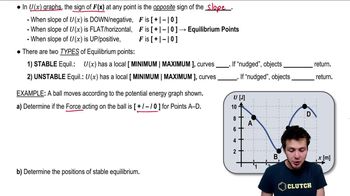
The equilibrium position of a spring is the point at which the spring is neither compressed nor extended, meaning the net force acting on it is zero. In the context of the problem, the equilibrium lengths L₁ and L₂ represent the lengths of the springs when no external forces are applied, which is crucial for calculating the total displacement caused by the suspended masses.
추천 영상:
05:50
Forces & Equilibrium Positions

Gravitational Force

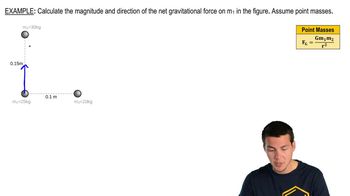
Gravitational force is the attractive force between two masses, calculated using Newton's law of universal gravitation, F = mg, where m is the mass and g is the acceleration due to gravity. In this scenario, the gravitational forces acting on masses m₁ and m₂ will determine how much each spring stretches, ultimately affecting the position of m₂ relative to the ceiling.
추천 영상:
05:41
Gravitational Forces in 2D
관련 실천
교과서 질문

A 50 g rock is placed in a slingshot and the rubber band is stretched. The magnitude of the force of the rubber band on the rock is shown by the graph in FIGURE P9.56. The rubber band is stretched 30 cm and then released. What is the speed of the rock?

2103
views
1
rank
교과서 질문

When you ride a bicycle at constant speed, nearly all the energy you expend goes into the work you do against the drag force of the air. Model a cyclist as having cross-section area 0.45 m² and, because the human body is not aerodynamically shaped, a drag coefficient of 0.90. Use 1.2 kg/m³ as the density of air at room temperature. Metabolic power is the rate at which your body 'burns' fuel to power your activities. For many activities, your body is roughly 25% efficient at converting the chemical energy of food into mechanical energy. What is the cyclist's metabolic power while cycling at 7.3 m/s?

545
views
교과서 질문

A horizontal spring with spring constant 250 N/m is compressed by 12 cm and then used to launch a 250 g box across the floor. The coefficient of kinetic friction between the box and the floor is 0.23. What is the box's launch speed?

3606
views
1
rank
교과서 질문

A 90 kg firefighter needs to climb the stairs of a 20-m-tall building while carrying a 40 kg backpack filled with gear. How much power does he need to reach the top in 55 s?

1959
views
교과서 질문

How much work does tension do to pull the mass from the bottom of the hill (θ = 0) to the top at constant speed? To answer this question, write an expression for the work done when the mass moves through a very small distance ds while it has angle θ, replace ds with an equivalent expression involving R and dθ, then integrate.

1707
views
교과서 질문

A hydroelectric power plant uses spinning turbines to transform the kinetic energy of moving water into electric energy with 80% efficiency. That is, 80% of the kinetic energy becomes electric energy. A small hydroelectric plant at the base of a dam generates 50 MW of electric power when the falling water has a speed of 18 m/s. What is the water flow rate - kilograms of water per second - through the turbines?

2694
views