
A 12 kg weather rocket generates a thrust of 200 N. The rocket, pointing upward, is clamped to the top of a vertical spring. The bottom of the spring, whose spring constant is 550 N/m, is anchored to the ground. Initially, before the engine is ignited, the rocket sits at rest on top of the spring. How much is the spring compressed?
Ch 09: Work and Kinetic Energy
9장, 문제 70b
A 12 kg weather rocket generates a thrust of 200 N. The rocket, pointing upward, is clamped to the top of a vertical spring. The bottom of the spring, whose spring constant is 550 N/m, is anchored to the ground. After the engine is ignited, what is the rocket’s speed when the spring has stretched 40 cm?
검증된 단계별 안내1
Step 1: Understand the problem. A geosynchronous orbit means the satellite has a period equal to the rotational period of the Earth, which is 24 hours. However, we will verify this by using Kepler's Third Law and the given altitude of the orbit.
Step 2: Write down Kepler's Third Law for circular orbits: , where T is the orbital period, r is the orbital radius, G is the gravitational constant, and M is the mass of the Earth.
Step 3: Calculate the orbital radius r. The orbital radius is the sum of the Earth's radius and the altitude of the satellite. Use the Earth's radius (approximately 6.37 x 10^6 m) and the given altitude (3.58 x 10^7 m) to find r: .
Step 4: Rearrange Kepler's Third Law to solve for T: . Substitute the values for G (6.674 x 10^-11 N·m²/kg²), M (5.972 x 10^24 kg), and r (calculated in Step 3).
Step 5: Simplify the expression to find T. Ensure the units are consistent (meters, kilograms, seconds) throughout the calculation. The result should confirm that the period is approximately 24 hours, as expected for a geosynchronous orbit.

비슷한 문제에 대한 검증된 영상 답변:
이 영상 해법은 위 문제에 도움이 된다고 튜터들이 추천한 것입니다.
영상 길이:
7m도움이 되었나요?
주요 개념
질문에 올바르게 답하기 위해 반드시 이해해야 하는 핵심 개념들은 다음과 같습니다.
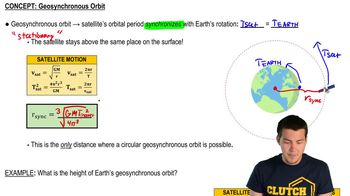
Geosynchronous Orbit
A geosynchronous orbit is a circular orbit around the Earth where a satellite's orbital period matches the Earth's rotation period, approximately 24 hours. This allows the satellite to remain fixed over a specific point on the equator, making it ideal for communication purposes. The altitude of such an orbit is about 35,786 kilometers (22,236 miles) above sea level.
추천 영상:
Geosynchronous Orbits
Orbital Period
The orbital period is the time it takes for a satellite to complete one full orbit around a celestial body. For geosynchronous satellites, this period is equal to the rotational period of the Earth, which is approximately 24 hours. This synchronization ensures that the satellite appears stationary relative to the Earth's surface.
추천 영상:
Geosynchronous Orbits
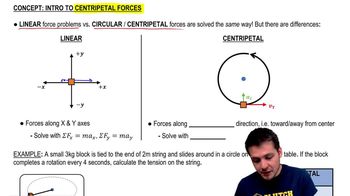
Centripetal Force
Centripetal force is the net force required to keep an object moving in a circular path, directed towards the center of the circle. In the context of satellites, gravitational force provides the necessary centripetal force to maintain the satellite's orbit. The balance between gravitational force and the satellite's inertia is crucial for stable orbiting.
추천 영상:
Intro to Centripetal Forces
관련 실천
교과서 질문
1435
views
교과서 질문
A gardener pushes a 12 kg lawnmower whose handle is tilted up 37° above horizontal. The lawnmower's coefficient of rolling friction is 0.15. How much power does the gardener have to supply to push the lawnmower at a constant speed of 1.2 m/s? Assume his push is parallel to the handle.
2449
views
1
rank
교과서 질문
Draw a pictorial representation.
815
views
교과서 질문
Finish the solution of the problem.
1973
views
