
Ch 09: Work and Kinetic Energy
Knight Calc - Physics for Scientists and Engineers 5th Edition
Knight Calc5th EditionPhysics for Scientists and EngineersISBN: 9780137344796당신이 사용하는 게 아니라요?교과서 변경
9장, 문제 69b

Draw a pictorial representation.
T−(1500kg)(9.8m/s2)=(1500kg)(1.0m/s2)T-(1500\,\(\text{kg}\))(9.8\,\(\text{m/s}\)^2)=(1500\,\(\text{kg}\))\(\left\)(1.0\,\(\text{m/s}\)^2\(\right\))
P=T(2.0m/s)P=T(2.0\,\(\text{m/s}\))

검증된 단계별 안내
1
Step 1: Start by analyzing the given equations. The first equation represents the forces acting on an object, where T is the tension in the rope, and the forces include the weight of the object (mass × gravitational acceleration) and the net force (mass × acceleration). The second equation relates the power (P) to the tension (T) and velocity (v).
Step 2: Rewrite the first equation to solve for the tension (T). The equation is T - (1500 kg)(9.8 m/s²) = (1500 kg)(1.0 m/s²). Rearrange it to isolate T: T = (1500 kg)(9.8 m/s²) + (1500 kg)(1.0 m/s²).
Step 3: Substitute the known values for mass (1500 kg), gravitational acceleration (9.8 m/s²), and acceleration (1.0 m/s²) into the equation for T. This will give you the numerical value of the tension.
Step 4: Use the second equation, P = T(2.0 m/s), to calculate the power. Substitute the value of T obtained from Step 3 into this equation.
Step 5: Multiply the tension (T) by the velocity (2.0 m/s) to find the power (P). This will give you the final result for the power output.

비슷한 문제에 대한 검증된 영상 답변:

이 영상 해법은 위 문제에 도움이 된다고 튜터들이 추천한 것입니다.

주요 개념

질문에 올바르게 답하기 위해 반드시 이해해야 하는 핵심 개념들은 다음과 같습니다.

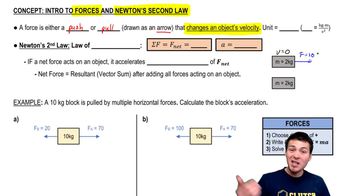
Newton's Second Law of Motion

Newton's Second Law states that the acceleration of an object is directly proportional to the net force acting on it and inversely proportional to its mass. This relationship is expressed mathematically as F = ma, where F is the net force, m is the mass, and a is the acceleration. In the context of the given question, it helps to analyze the forces acting on the 1500 kg object and how they relate to its acceleration.
추천 영상:
가이드 코스
06:54
Intro to Forces & Newton's Second Law

Tension Force

Tension is a force that is transmitted through a string, rope, or cable when it is pulled tight by forces acting from opposite ends. In the equation provided, T represents the tension in the rope or cable supporting the mass. Understanding how tension interacts with gravitational force and acceleration is crucial for solving the problem effectively.
추천 영상:
가이드 코스
06:48
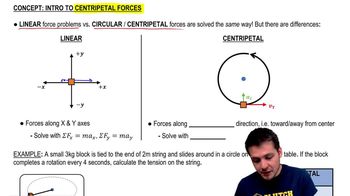
Intro to Centripetal Forces

Power

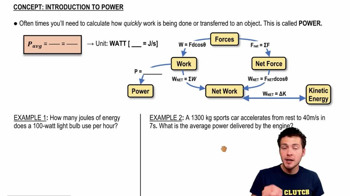
Power is defined as the rate at which work is done or energy is transferred over time. It can be calculated using the formula P = Fv, where P is power, F is the force applied, and v is the velocity of the object. In the context of the question, the power equation P = T(2.0 m/s) indicates how the tension in the rope contributes to the power output when the object moves at a specific velocity.
추천 영상:
관련 실천
교과서 질문

A 12 kg weather rocket generates a thrust of 200 N. The rocket, pointing upward, is clamped to the top of a vertical spring. The bottom of the spring, whose spring constant is 550 N/m, is anchored to the ground. Initially, before the engine is ignited, the rocket sits at rest on top of the spring. How much is the spring compressed?

1435
views
교과서 질문

Astronomers using a 2.0-m-diameter telescope observe a distant supernova - an exploding star. The telescope's detector records 9.1 x 10⁻¹¹ J of light energy during the first 10 s. It's known that this type of supernova has a visible-light power output of 5.0 x 1037 W for the first 10 s of the explosion. How distant is the supernova? Give your answer in light years, where one light year is the distance light travels in one year. The speed of light is 3.0 x 10⁸ m/s.

2251
views
교과서 질문

A 12 kg weather rocket generates a thrust of 200 N. The rocket, pointing upward, is clamped to the top of a vertical spring. The bottom of the spring, whose spring constant is 550 N/m, is anchored to the ground. After the engine is ignited, what is the rocket’s speed when the spring has stretched 40 cm?

3234
views
교과서 질문

Write a realistic problem for which this is the correct equation(s).

T−(1500kg)(9.8m/s2)=(1500kg)(1.0m/s2)T-(1500\,\(\text{kg}\))(9.8\,\(\text{m/s}\)^2)=(1500\,\(\text{kg}\))\(\left\)(1.0\,\(\text{m/s}\)^2\(\right\))

P=T(2.0m/s)P=T(2.0\,\(\text{m/s}\))

1907
views
교과서 질문

Finish the solution of the problem.

T−(1500kg)(9.8m/s2)=(1500kg)(1.0m/s2)T-(1500\,\(\text{kg}\))(9.8\,\(\text{m/s}\)^2)=(1500\,\(\text{kg}\))\(\left\)(1.0\,\(\text{m/s}\)^2\(\right\))

P=T(2.0m/s)P=T(2.0\,\(\text{m/s}\))

1973
views
교과서 질문

A farmer uses a tractor to pull a 150 kg bale of hay up a 15° incline to the barn at a steady 5.0 km/h. The coefficient of kinetic friction between the bale and the ramp is 0.45. What is the tractor's power output?

2173
views