Ch 10: Interactions and Potential Energy
Knight Calc - Physics for Scientists and Engineers 5th Edition
Knight Calc5th EditionPhysics for Scientists and EngineersISBN: 9780137344796당신이 사용하는 게 아니라요?교과서 변경
10장, 문제 6

A 55 kg skateboarder wants to just make it to the upper edge of a 'quarter pipe,' a track that is one-quarter of a circle with a radius of 3.0 m. What speed does he need at the bottom?

검증된 단계별 안내
1
Step 1: Identify the type of energy transformation involved. The skateboarder starts with kinetic energy at the bottom of the quarter pipe and converts it into gravitational potential energy at the top. Use the principle of conservation of energy to solve the problem.
Step 2: Write the equation for conservation of energy: \( KE_{bottom} = PE_{top} \). The kinetic energy at the bottom is \( KE = \frac{1}{2}mv^2 \), and the potential energy at the top is \( PE = mgh \).
Step 3: Determine the height \( h \) of the quarter pipe. Since the quarter pipe is one-quarter of a circle with radius \( r = 3.0 \ \text{m} \), the height \( h \) is equal to the radius of the circle: \( h = r = 3.0 \ \text{m} \).
Step 4: Substitute the known values into the energy equation. The mass of the skateboarder is \( m = 55 \ \text{kg} \), the height is \( h = 3.0 \ \text{m} \), and the acceleration due to gravity is \( g = 9.8 \ \text{m/s}^2 \). The equation becomes \( \frac{1}{2}mv^2 = mgh \).
Step 5: Solve for the speed \( v \) at the bottom. Cancel \( m \) from both sides of the equation, leaving \( \frac{1}{2}v^2 = gh \). Rearrange to find \( v = \sqrt{2gh} \). Substitute \( g = 9.8 \ \text{m/s}^2 \) and \( h = 3.0 \ \text{m} \) into the equation to calculate the required speed.

비슷한 문제에 대한 검증된 영상 답변:

이 영상 해법은 위 문제에 도움이 된다고 튜터들이 추천한 것입니다.
영상 길이:
5m
도움이 되었나요?

주요 개념

질문에 올바르게 답하기 위해 반드시 이해해야 하는 핵심 개념들은 다음과 같습니다.

Conservation of Energy

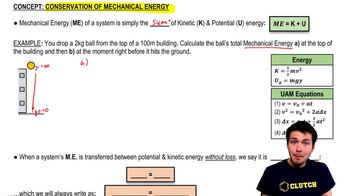
The principle of conservation of energy states that the total energy in a closed system remains constant. In this scenario, the skateboarder converts kinetic energy (energy of motion) at the bottom of the quarter pipe into potential energy (stored energy due to height) as he ascends. The initial kinetic energy must equal the potential energy at the top for him to just reach the edge.
추천 영상:
가이드 코스
06:24
Conservation Of Mechanical Energy

Kinetic Energy

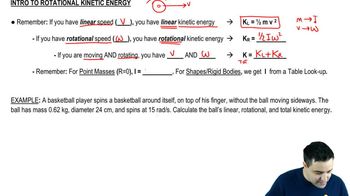
Kinetic energy is the energy an object possesses due to its motion, calculated using the formula KE = 1/2 mv², where m is mass and v is velocity. For the skateboarder, his kinetic energy at the bottom of the quarter pipe must be sufficient to overcome gravitational potential energy as he climbs, allowing him to reach the height of the quarter pipe.
추천 영상:
가이드 코스
06:07
Intro to Rotational Kinetic Energy

Gravitational Potential Energy

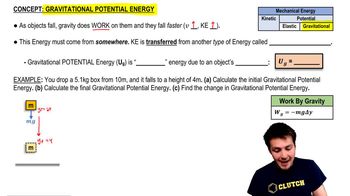
Gravitational potential energy is the energy an object has due to its position in a gravitational field, given by the formula PE = mgh, where m is mass, g is the acceleration due to gravity, and h is height. In this case, as the skateboarder ascends the quarter pipe, he gains potential energy that must equal the kinetic energy he had at the bottom to just make it to the top.
추천 영상:
가이드 코스
06:35
Gravitational Potential Energy