Ch 10: Interactions and Potential Energy
Knight Calc - Physics for Scientists and Engineers 5th Edition
Knight Calc5th EditionPhysics for Scientists and EngineersISBN: 9780137344796당신이 사용하는 게 아니라요?교과서 변경
10장, 문제 10

The spring in FIGURE EX10.21a is compressed by 10 cm. It launches a block across a frictionless surface at 0.50 m/s. The two springs in Figure EX10.21b are identical to the spring of Figure EX10.21a. They are compressed by the same 10 cm and launch the same block. What is the block's speed now?

검증된 단계별 안내
1
Identify the energy transformation involved: Initially, the potential energy stored in the compressed spring is converted into the kinetic energy of the block as it is launched.
Calculate the initial potential energy stored in the spring using the formula for spring potential energy, PE = 0.5 * k * x^2, where 'k' is the spring constant and 'x' is the compression distance.
Determine the kinetic energy of the block using the formula KE = 0.5 * m * v^2, where 'm' is the mass of the block and 'v' is its velocity. Use the velocity given for the single spring setup to find the kinetic energy.
For the setup with two springs, assume that the potential energy stored in the system when both springs are compressed is twice that of the single spring, since both springs are identical and compressed by the same amount.
Use the conservation of energy principle to equate the total potential energy from the two springs to the kinetic energy of the block and solve for the new velocity 'v' of the block.

비슷한 문제에 대한 검증된 영상 답변:

이 영상 해법은 위 문제에 도움이 된다고 튜터들이 추천한 것입니다.
영상 길이:
6m
도움이 되었나요?

주요 개념

질문에 올바르게 답하기 위해 반드시 이해해야 하는 핵심 개념들은 다음과 같습니다.

Hooke's Law

Hooke's Law states that the force exerted by a spring is directly proportional to its displacement from the equilibrium position, expressed as F = -kx, where k is the spring constant and x is the displacement. This principle is crucial for understanding how the potential energy stored in a compressed spring is converted into kinetic energy when the spring is released.
추천 영상:
가이드 코스
05:27
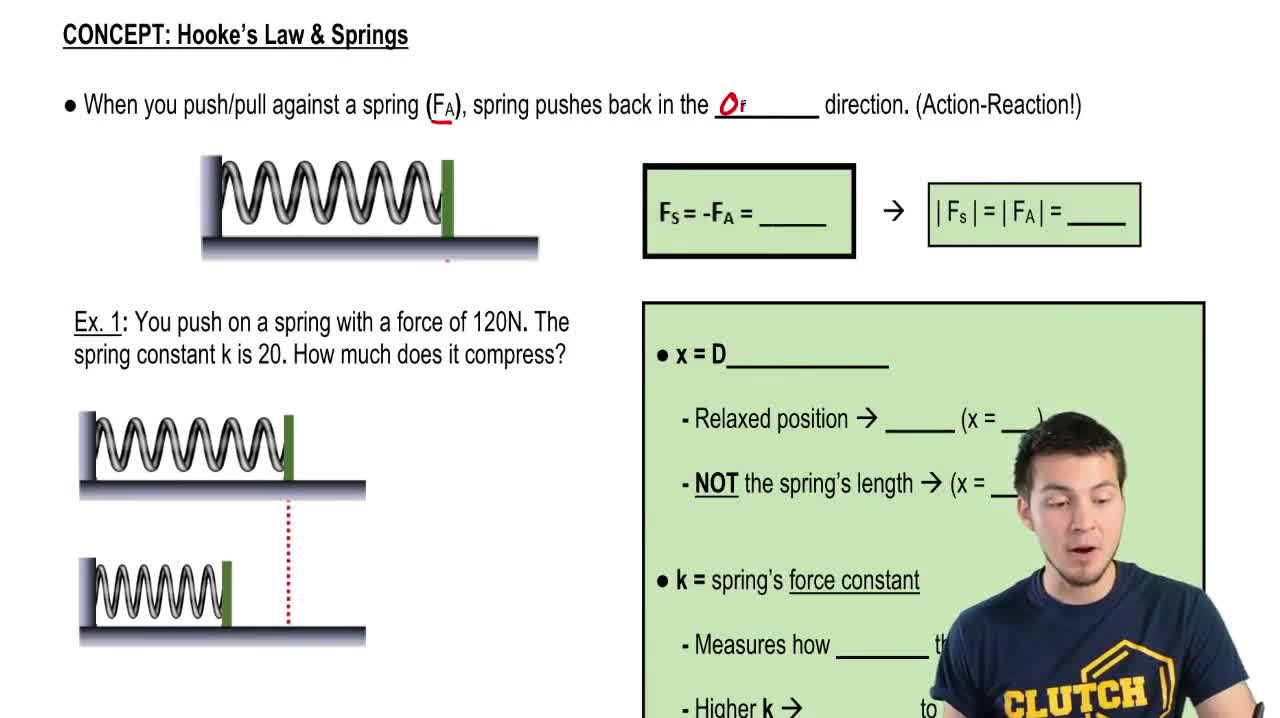
Spring Force (Hooke's Law)

Conservation of Energy

The principle of conservation of energy states that energy cannot be created or destroyed, only transformed from one form to another. In this scenario, the potential energy stored in the compressed spring is converted into kinetic energy of the block as it is launched. This concept allows us to analyze the relationship between the initial and final speeds of the block.
추천 영상:
가이드 코스
06:24
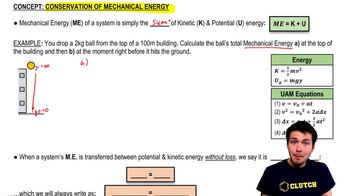
Conservation Of Mechanical Energy

Kinetic Energy

Kinetic energy is the energy possessed by an object due to its motion, calculated using the formula KE = 1/2 mv², where m is the mass and v is the velocity of the object. Understanding kinetic energy is essential for determining how the speed of the block changes when launched by the springs, especially when comparing the effects of multiple springs acting on the same mass.
추천 영상:
가이드 코스
06:07
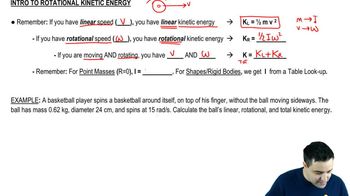
Intro to Rotational Kinetic Energy
관련 실천
교과서 질문

A pendulum is made by tying a 500 g ball to a 75-cm-long string. The pendulum is pulled 30° to one side, then released. What is the ball's speed at the lowest point of its trajectory?

2052
views

교과서 질문

The free-fall acceleration on a large asteroid, in the vacuum of space, is 0.15 m/s2. A spacecraft hovering 500 m above the surface drops a 25 kg payload wrapped in a padded jacket. What is the payload's impact speed?

2648
views
교과서 질문

The maximum energy a bone can absorb without breaking is surprisingly small. Experimental data show that a leg bone of a healthy, 60 kg human can absorb about 200 J. From what maximum height could a 60 kg person jump and land rigidly upright on both feet without breaking his legs? Assume that all energy is absorbed by the leg bones in a rigid landing.

3448
views
교과서 질문

A 55 kg skateboarder wants to just make it to the upper edge of a 'quarter pipe,' a track that is one-quarter of a circle with a radius of 3.0 m. What speed does he need at the bottom?

2096
views
교과서 질문

A 1500 kg car traveling at 10 m/s suddenly runs out of gas while approaching the valley shown in FIGURE EX10.11. The alert driver immediately puts the car in neutral so that it will roll. What will be the car's speed as it coasts into the gas station on the other side of the valley? Ignore rolling friction.

2777
views
1
rank
교과서 질문

A 20 kg child is on a swing that hangs from 3.0-m-long chains. What is her maximum speed if she swings out to a 45° angle?

2385
views
1
rank