
Ch 10: Interactions and Potential Energy
Knight Calc - Physics for Scientists and Engineers 5th Edition
Knight Calc5th EditionPhysics for Scientists and EngineersISBN: 9780137344796당신이 사용하는 게 아니라요?교과서 변경
10장, 문제 52a

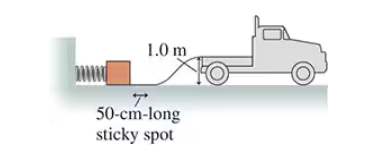
A freight company uses a compressed spring to shoot 2.0 kg packages up a 1.0-m-high frictionless ramp into a truck, as FIGURE P10.52 shows. The spring constant is 500 N/m and the spring is compressed 30 cm. What is the speed of the package when it reaches the truck?

검증된 단계별 안내
1
Step 1: Identify the energy transformations in the system. The spring's potential energy is converted into the package's kinetic energy and gravitational potential energy as it moves up the ramp. Use the principle of conservation of energy to solve the problem.
Step 2: Write the formula for the spring's potential energy: \( U_s = \frac{1}{2} k x^2 \), where \( k \) is the spring constant (500 N/m) and \( x \) is the compression distance (0.30 m). Substitute these values to calculate the spring's potential energy.
Step 3: Write the formula for gravitational potential energy: \( U_g = m g h \), where \( m \) is the mass of the package (2.0 kg), \( g \) is the acceleration due to gravity (9.8 m/s²), and \( h \) is the height of the ramp (1.0 m). Substitute these values to calculate the gravitational potential energy.
Step 4: Apply the conservation of energy principle: \( U_s = K + U_g \), where \( K \) is the kinetic energy of the package at the top of the ramp. Rearrange the equation to solve for \( K \): \( K = U_s - U_g \). Use the values calculated in Steps 2 and 3.
Step 5: Use the formula for kinetic energy: \( K = \frac{1}{2} m v^2 \), where \( v \) is the speed of the package. Rearrange the equation to solve for \( v \): \( v = \sqrt{\frac{2K}{m}} \). Substitute the value of \( K \) from Step 4 and the mass of the package to find the speed.

비슷한 문제에 대한 검증된 영상 답변:

이 영상 해법은 위 문제에 도움이 된다고 튜터들이 추천한 것입니다.
영상 길이:
6m
도움이 되었나요?

주요 개념

질문에 올바르게 답하기 위해 반드시 이해해야 하는 핵심 개념들은 다음과 같습니다.

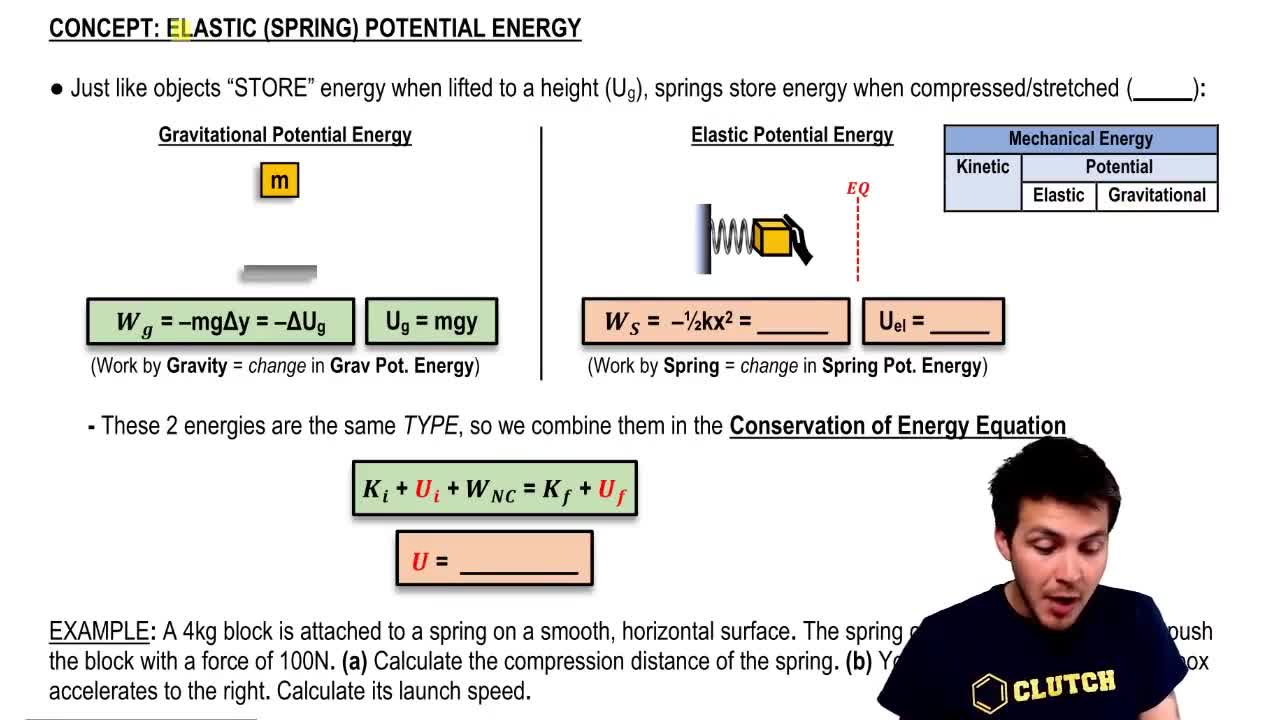
Potential Energy of a Spring

The potential energy stored in a compressed spring is given by the formula PE_spring = (1/2)kx^2, where k is the spring constant and x is the compression distance. In this scenario, the spring constant is 500 N/m and the spring is compressed by 0.3 m, allowing us to calculate the energy available to propel the package.
추천 영상:
가이드 코스
06:18
Energy in Horizontal Springs

Conservation of Energy

The principle of conservation of energy states that energy cannot be created or destroyed, only transformed from one form to another. In this problem, the potential energy stored in the spring is converted into kinetic energy as the package moves up the ramp, allowing us to relate the energies to find the speed of the package.
추천 영상:
가이드 코스
06:24
Conservation Of Mechanical Energy

Kinetic Energy

Kinetic energy (KE) is the energy of an object due to its motion, calculated using the formula KE = (1/2)mv^2, where m is the mass and v is the velocity. To find the speed of the package when it reaches the truck, we will equate the kinetic energy to the potential energy converted from the spring and the gravitational potential energy gained while moving up the ramp.
추천 영상:
가이드 코스
06:07
Intro to Rotational Kinetic Energy
관련 실천
교과서 질문

A horizontal spring with spring constant 100 N/m is compressed 20 cm and used to launch a 2.5 kg box across a frictionless, horizontal surface. After the box travels some distance, the surface becomes rough. The coefficient of kinetic friction of the box on the surface is 0.15. Use work and energy to find how far the box slides across the rough surface before stopping.

2191
views
교과서 질문

The spring shown in FIGURE P10.54 is compressed 50 cm and used to launch a 100 kg physics student. The track is frictionless until it starts up the incline. The student's coefficient of kinetic friction on the 30° incline is 0.15. What is the student's speed just after losing contact with the spring?

<Image>

2814
views
교과서 질문

Two blocks with masses mA and mB are connected by a massless string over a massless, frictionless pulley. Block B, which is more massive than block A, is released from height h and falls. Write an expression for the speed of the blocks just as block B reaches the ground.

2126
views
교과서 질문

FIGURE 10.23 showed the potential-energy curve for the O2 molecule. Consider a molecule with the energy E1 shown in the figure. a. What is the maximum speed of an oxygen atom as it oscillates back and forth? Don't forget that the kinetic energy is the total kinetic energy of the system. The mass of an oxygen atom is 16 u, where 1u=1 atomic mass unit =1.66×10⁻²⁷ kg .

2633
views
교과서 질문

Two blocks with masses mA and mB are connected by a massless string over a massless, frictionless pulley. Block B, which is more massive than block A, is released from height h and falls. A 1.0 kg block and a 2.0 kg block are connected by a massless string over a massless, frictionless pulley. The impact speed of the heavier block, after falling, is 1.8 m/s. From how high did it fall?

3535
views
교과서 질문

The ice cube is replaced by a 50 g plastic cube whose coefficient of kinetic friction is 0.20. How far will the plastic cube travel up the slope? Use work and energy.

1979
views